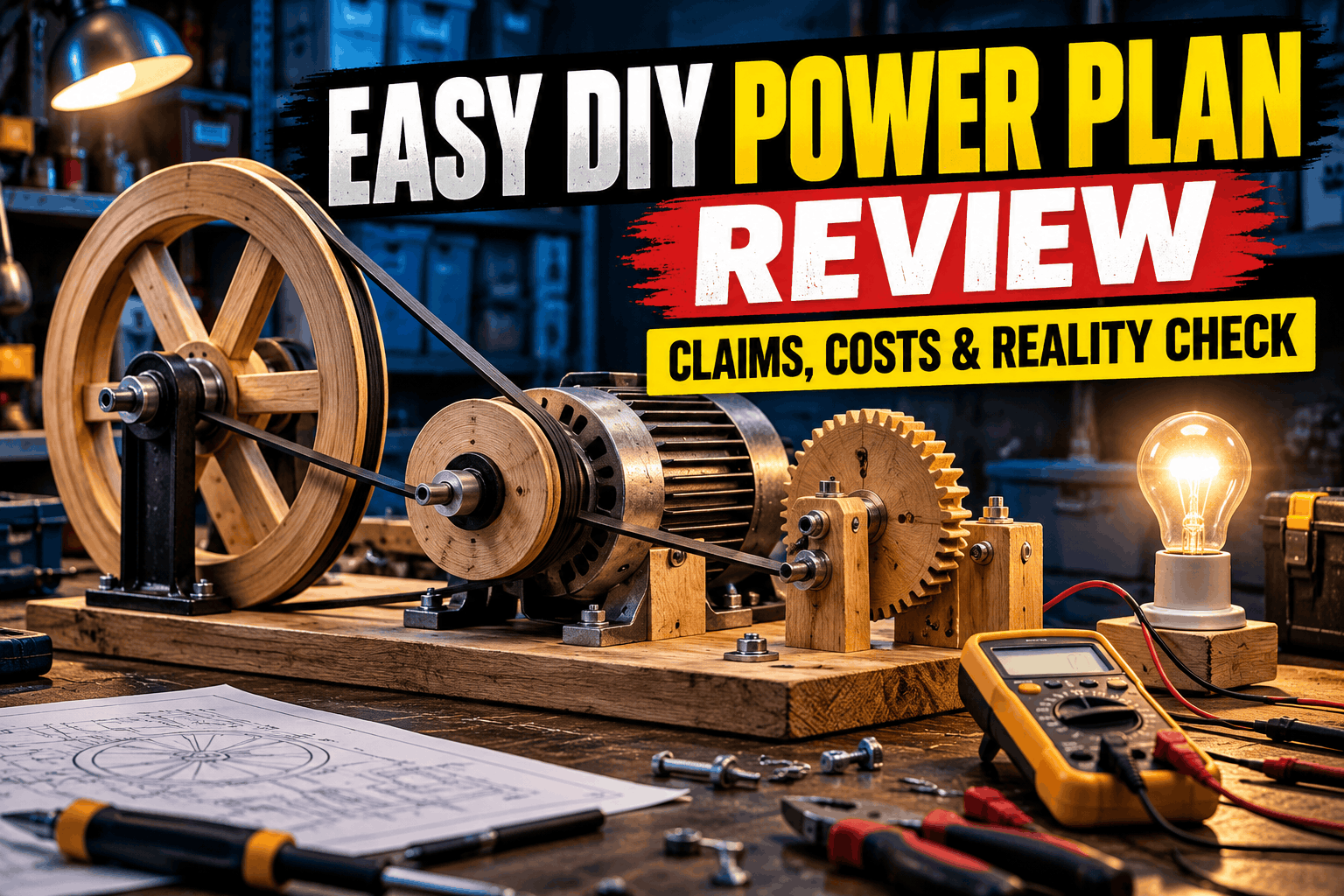
Easy DIY Power Plan review examining the advertised generator design, construction costs, and claims about household electricity.
Easy DIY Power Plan is a digital guide marketed as a way to build a homemade generator using simple mechanical components and step-by-step instructions. The sales page claims that the device can generate electricity continuously, power household appliances, and dramatically reduce electricity bills. But are those promises realistic? This Easy DIY Power Plan review examines what the digital product includes, what it costs, the advertised guarantee, and the most important technical concerns to understand before buying.
The Easy DIY Power Plan is aimed at people interested in DIY projects, alternative energy, and household preparedness. Its promotional story describes a homemade setup using wooden wheels, belts, a cylinder, and cogwheels. The seller claims that the device can power appliances while supplying its own energy. That central claim is not supported by the established principles of energy conservation, so it should not be treated as a reliable way to power a home.
This Easy DIY Power Plan review separates the product’s advertised features from what can reasonably be concluded about its performance. We also cover the listed price, downloadable materials, customer support claims, and the seller’s 60-day refund offer.
Research-Based Review:, Based on published product information and research, we have not independently tested this product.
Quick Review: Easy DIY Power Plan
| Product type | Digital DIY generator guide |
|---|---|
| Listed price | $49; confirm the current checkout price |
| Main advertised concept | A homemade mechanical generator using wheels, belts, and gears |
| Included materials | Digital guide, blueprints, illustrated instructions, tools and materials lists |
| Advertised construction cost | Approximately $106 according to the seller; actual costs may vary |
| Support | Unlimited lifetime support advertised by the seller |
| Refund policy | 60-day money-back guarantee advertised by the seller |
| Independent performance testing | Not performed for this review |
| Our assessment | Treat as an educational DIY guide, not a proven source of free household electricity |
Product details reflect the workbook and published sales material. Confirm current pricing, access, support, and refund conditions before purchasing.
What Is Easy DIY Power Plan?
Easy DIY Power Plan is a downloadable guide promoted as a blueprint for building a small homemade power-generation device. The sales presentation tells the story of a person named Ryan Taylor, who claims to have developed a mechanical system with help from an engineer.
According to the seller, the design uses components such as wooden wheels, belts, a cylinder, and cogwheels. The guide is advertised as providing instructions for assembling the parts and connecting the resulting device to electrical appliances.
The sales page also claims that the system can keep running while supplying its own energy. This is the most significant issue to consider. A rotating mechanism cannot continuously supply energy to itself and external appliances without an adequate energy input. Mechanical friction, electrical resistance, and generator losses all consume energy rather than create it.
Therefore, Easy DIY Power Plan should not be confused with a verified generator, a solar power system, a battery backup, or a professionally engineered off-grid installation. The purchase is a digital information product, and the performance claims require independent evidence.
What Does Easy DIY Power Plan Include?
The product’s sales page advertises several downloadable resources intended to help buyers understand and assemble the proposed device. The following features describe what the seller says is included; they do not confirm that the design can deliver the advertised electrical output.
1. Step-by-Step Digital Guide
The main Easy DIY Power Plan guide is presented as a beginner-friendly set of instructions. The seller says it explains the construction process in a simplified format so readers can follow the proposed design without advanced engineering experience.
A structured guide can be convenient for learning about a DIY project. However, clear instructions do not establish that the underlying design can generate enough energy to power appliances or operate indefinitely.
2. Blueprints and Illustrated Instructions
The offer includes blueprints and illustrated directions intended to show how the parts fit together. The sales material says users can access the files on a computer, tablet, or smartphone and print the documents when needed.
These materials may help explain the intended mechanical arrangement. Before spending money on parts or attempting assembly, buyers should look for complete technical specifications, realistic operating limits, and credible evidence showing the device’s input energy and electrical output.
3. Tools and Materials List
The seller says the package includes a materials list and a guide to the tools needed for construction. Its sales page estimates that the physical components could cost about $106, depending on the availability of suitable materials.
That estimate is a seller-provided figure, not an independently verified bill of materials. Actual costs can vary by location, material quality, required tools, shipping, and the need to replace or modify components.
4. Downloadable Access
Easy DIY Power Plan is advertised as a digital product. The sales page says customers can download the guide and related documents after completing their purchase. The product images are described as visualizations rather than a physical generator included with the order.
Buyers should confirm the exact files and access arrangements on the checkout page. Purchasing the guide does not itself provide a finished generator, a tested power supply, or a professional installation.
Does Easy DIY Power Plan Really Generate Unlimited Electricity?
This is the central question in any Easy DIY Power Plan review. The seller claims that a small mechanical setup can keep powering itself while also producing electricity for lights, a refrigerator, a television, and other household appliances.
That description conflicts with the established principle of conservation of energy. Energy can be converted from one form to another, but a machine cannot continuously create more energy than it receives. In a real generator, some input energy is lost through friction, heat, electrical resistance, and other inefficiencies.
The sales presentation refers to electric cars and a supposed energy-multiplication principle. Electric vehicles do not create unlimited energy by rotating their wheels. Regenerative braking recovers some energy that would otherwise be lost while slowing down, but the vehicle still requires an external energy source, such as charging from the electrical grid.
The sales page’s claims about self-powering operation and dramatic reductions in household electricity costs are not established by the promotional story alone. Without independently verified measurements of energy input, electrical output, operating duration, and connected loads, those claims should not be accepted as proven.
For anyone considering this product, the distinction is important: a mechanical DIY project may demonstrate movement or produce some electricity when driven by an external energy source. That is not the same as a self-sustaining generator capable of continuously powering a home.
Can Easy DIY Power Plan Reduce Your Electricity Bill?
The seller advertises substantial electricity-bill reductions, including a claim that the proposed system could reduce bills by 60% or more. The sales page also makes much larger long-term savings claims.
Those figures have not been independently verified for this review. No reliable savings estimate can be made without knowing the device’s actual electrical output, the amount of energy it consumes, its operating costs, and the household’s electricity use.
If your goal is to lower utility bills, compare options with measurable performance data. Depending on your situation, these might include improving insulation, using efficient appliances, reducing unnecessary electricity consumption, or evaluating a properly sized solar and battery system.
Easy DIY Power Plan should not be purchased on the assumption that it will eliminate electricity bills. Treat the savings figures as marketing claims until credible, independent evidence demonstrates otherwise.
Easy DIY Power Plan Pros and Cons
Potential Advantages
- Organized learning materials: The seller advertises a guide, blueprints, illustrated instructions, and a materials list in one package.
- Digital format: Downloadable documents can be accessed on supported personal devices, according to the sales page.
- DIY project interest: The proposed mechanical design may interest readers who enjoy studying wheels, belts, gears, and basic mechanical assemblies.
- Advertised customer support: The seller states that lifetime support is included, although we have not independently verified the service.
- Advertised refund period: A 60-day money-back guarantee is promoted, subject to the seller’s current terms.
Potential Disadvantages
- Unproven central claim: The claim that the device powers itself while producing surplus energy conflicts with energy-conservation principles.
- No independent test in this review: We have not built or tested the device, and the advertised household performance has not been verified here.
- Extra construction costs: The guide price does not include the physical parts and tools needed to attempt the project.
- Potentially misleading savings expectations: The seller’s bill-reduction and lifetime-savings figures are not established by the supplied promotional material.
- Not a ready-to-use generator: The advertised purchase is digital information, not a finished power system.
- Technical and electrical risks: Poorly designed rotating machinery and electrical connections can cause injury, equipment damage, or fire.
Is Easy DIY Power Plan Beginner-Friendly?
The sales page presents Easy DIY Power Plan as suitable for people without advanced technical skills. It describes the assembly as straightforward and says the project can be completed in several hours.
Those statements are promotional descriptions, not independently measured construction results. The actual difficulty will depend on the quality of the instructions, the parts used, the builder’s experience, and the need for accurate mechanical alignment and safe electrical connections.
Beginners should be particularly cautious about connecting an experimental device to household wiring or appliances. Do not connect a homemade generator to a home’s electrical circuits without properly designed equipment and a qualified electrician. Improper connections can cause electric shock, fire, or dangerous backfeeding into utility lines.
Price and Money-Back Guarantee
The product workbook lists Easy DIY Power Plan at $49. The sales page also promotes a 60-day money-back guarantee and says lifetime customer support is included. These are seller-advertised terms and should be confirmed on the current checkout page before ordering.
The guide’s price is separate from the cost of building the proposed device. The seller estimates the components at approximately $106, but that amount may vary and has not been independently confirmed. A buyer should consider the combined cost of the digital guide, materials, tools, and any additional work required.
Before purchasing, review the refund conditions, support contact details, digital access arrangements, and any limitations. Keep the order confirmation and a copy of the terms shown at checkout. We have not independently tested the refund process or verified the availability of lifetime support.
Important Safety Considerations
Electrical and mechanical safety: Do not rely on an experimental homemade generator for essential power, emergency heating, refrigeration, or medical equipment.
- Never connect an unverified generator directly to household wiring or utility lines.
- Keep hands, clothing, and loose objects away from rotating wheels, belts, and gears.
- Use appropriate guards, secure mounting, and suitable protective equipment when working with moving machinery.
- Have electrical components and wiring assessed by a qualified professional when necessary.
- Do not assume that a device is safe simply because the sales page describes it as low-risk or easy to assemble.
A guide is not a substitute for engineering validation, electrical safety standards, or professional installation.
Who Might Consider Easy DIY Power Plan?
Easy DIY Power Plan may interest readers who want to examine a digital DIY guide, learn about mechanical assemblies, or understand how the seller proposes to arrange wheels, belts, and gears. It may be approached as an educational concept to evaluate critically rather than as a proven energy solution.
It is not a suitable choice for anyone expecting guaranteed free electricity, a verified self-powering generator, or dependable backup power for a household. Buyers who need actual energy independence should focus on systems with documented output, appropriate safety protections, and credible performance data.
What to Check Before Buying
- Confirm the current purchase price and the exact digital files included.
- Read the seller’s refund policy and support terms before paying.
- Account for the separate cost of parts, tools, and construction.
- Ask whether independent test data is available for the claimed electrical output.
- Look for measurements of input energy, output energy, load capacity, and continuous operating time.
- Do not rely on promotional testimonials or claimed savings as proof of performance.
- Choose a tested generator or professionally designed renewable-energy system when reliable household power is the objective.
Review the Current Easy DIY Power Plan Offer
Check the current price, digital materials, support terms, and 60-day guarantee before deciding whether this guide meets your needs.
Affiliate Disclosure: This article contains an affiliate link. If you purchase through it, we may earn a commission at no additional cost to you. This does not change our aim of assessing the product’s claims and limitations fairly.
Final Verdict: Is Easy DIY Power Plan Worth It?
Easy DIY Power Plan is a digital guide that advertises blueprints, illustrated instructions, a materials list, and customer support for building a homemade mechanical generator. Those materials may interest people who want to examine a DIY project, but they do not establish that the proposed device can produce continuous surplus energy.
The biggest concern is the seller’s claim that the generator powers itself while supplying household appliances. That claim conflicts with established energy-conservation principles, and the sales presentation does not provide enough independently verified evidence to justify relying on it for household electricity or expecting the advertised bill savings.
Our conclusion: Consider Easy DIY Power Plan only with realistic expectations and a willingness to evaluate the design critically. Do not buy it expecting a proven source of unlimited electricity or guaranteed savings. If your main objective is reliable backup power or lower energy costs, compare solutions with documented performance, suitable safety protections, and verifiable operating costs before spending money.
Frequently Asked Questions
Is Easy DIY Power Plan a physical generator?
No. The offer is marketed as a digital guide containing blueprints, instructions, and materials information. The purchase does not include a completed generator or all the parts needed to build one.
What is the advertised construction cost?
The seller estimates that the physical components could cost about $106. This is a promotional estimate, not an independently verified total, and the actual cost may vary depending on materials, tools, and local prices.
Does the guide include a refund guarantee?
The seller advertises a 60-day money-back guarantee. Review the current checkout terms and refund instructions before purchasing, since this review has not independently tested the refund process.
Can Easy DIY Power Plan eliminate household electricity bills?
That outcome has not been independently established. The claim that the device can continuously power itself while supplying household appliances conflicts with energy-conservation principles. Do not rely on the product as a proven source of free electricity.
About the Author