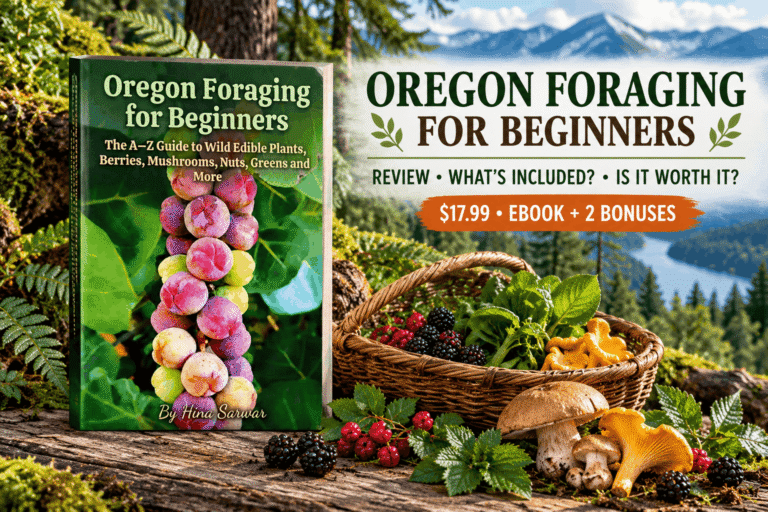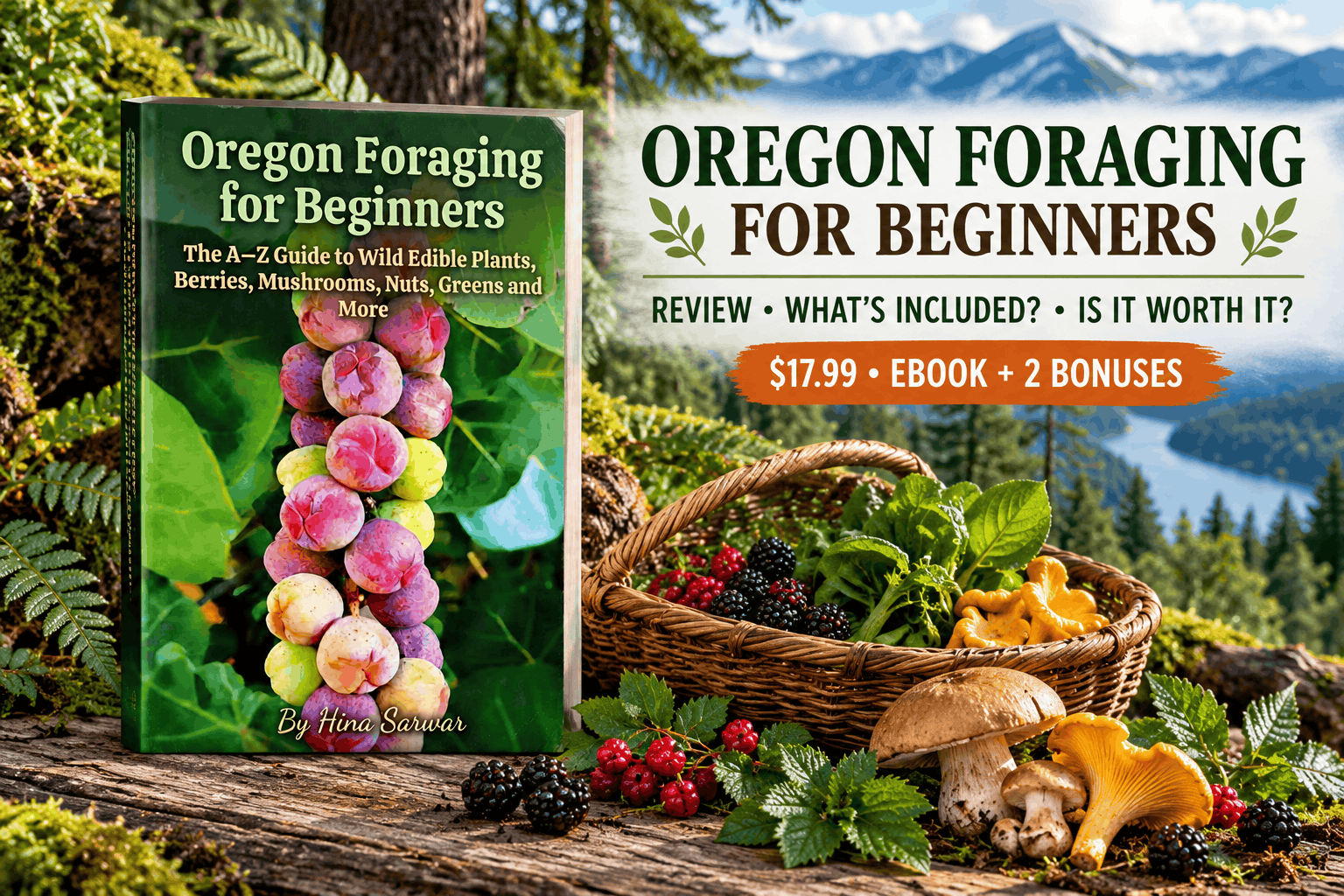
Oregon Foraging For Beginners Review — a look at the beginner ebook, its printable bonuses, price, and key safety considerations.
Curious about identifying wild edible plants, berries, greens, nuts, and mushrooms in Oregon? This Oregon Foraging For Beginners Review examines what the ebook includes, its practical learning approach, the bonus materials, its price, and the important limitations beginners should understand before purchasing.
The guide is designed to help new foragers learn step by step instead of attempting to memorize numerous species at once. However, educational material should be treated as a starting point—not as a substitute for expert identification, local regulations, or established food-safety practices.
Research-Based Review: Based on published product information and research, we have not independently tested this product.
Quick Review: Oregon Foraging For Beginners
What Is Oregon Foraging For Beginners?
Oregon Foraging For Beginners is a digital guide intended to introduce readers to the process of learning about wild foods found in Oregon. It addresses a common beginner challenge: knowing how to approach unfamiliar plants and natural foods without relying on guesswork.
Rather than presenting foraging as simply collecting whatever looks edible, the guide promotes a repeatable learning process. Readers are encouraged to observe a potential food source, identify it, verify that identification, harvest responsibly, and continue learning over time.
The product description also outlines a practical 30-day beginner foraging challenge. This may appeal to readers who prefer to build a learning habit through smaller steps instead of trying to study everything at once. The sales material does not establish that completing the challenge guarantees proficiency or makes someone an expert forager.
What Does the Guide Cover?
1. Getting Started and Understanding Habitats
The guide introduces safe, confident learning and the importance of understanding different Oregon foraging habitats. Habitat awareness can help beginners organise their observations and learn why location and growing conditions matter when studying a species.
2. Wild Greens, Berries, Nuts, and Seeds
Separate topics cover leafy greens, wild berries, nuts, and seeds. These categories give beginners a way to organise their learning and develop a personal reference system. The product description does not provide a complete, independently verified species list, so buyers should not assume every local edible species is covered.
3. A Cautious Introduction to Mushrooms
Mushroom foraging is included, but it deserves particular caution. Some poisonous mushrooms resemble edible varieties, and cooking does not make every poisonous mushroom safe. The Oregon Health Authority advises people not to eat wild mushrooms unless an experienced mushroom expert has identified them. Read the official Oregon mushroom safety guidance before considering any wild mushroom for consumption.
4. Seasons, Harvesting, and Food Preparation
The guide discusses seasonal observation, responsible harvesting, cleaning, handling, and preparing wild foods. These topics can help beginners think beyond identification alone and consider when a food might be available and how it should be handled.
5. A Repeatable Learning Framework
The product’s central process is Observe → Identify → Verify → Harvest Responsibly → Keep Learning. Its practical value depends on using reliable identification resources and being willing to leave a specimen unharvested whenever its identity or safety is uncertain.
What Bonuses Are Included?
According to the supplied product information, the Oregon Foraging For Beginners package includes the main ebook and two printable PDF bonuses.
Main Ebook
The core guide to beginning Oregon foraging, understanding wild-food categories, and developing a step-by-step learning process.
Oregon Seasonal Foraging Calendar
A printable PDF intended to help organise seasonal foraging observations and planning.
Oregon Foraging Logbook
A printable PDF for keeping personal notes and tracking learning experiences in the field.
The calendar and logbook could be useful for readers who like to record observations and revisit what they have learned. The sales copy describes digital delivery through the Digistore24 Download Vault, but buyers should check the checkout page for the exact files and access terms before ordering.
Oregon Foraging For Beginners: Pros and Cons
✓ Pros — What We Like
- Beginner-oriented structure: The step-by-step approach may feel more manageable than studying unrelated species at random.
- Broad introductory coverage: The product description includes greens, berries, nuts, seeds, mushrooms, seasonal topics, harvesting, and preparation.
- Practical learning tools: The seasonal calendar and logbook offer ways to organise observations.
- Learning through repetition: The proposed 30-day challenge gives readers a suggested structure for continued practice.
- Digital format: An ebook and printable PDFs can be convenient for home study and planning.
- Published refund promise: The sales copy advertises a 60-day money-back guarantee, subject to the seller’s actual terms.
✗ Cons — What to Keep in Mind
- Not a substitute for field experience: Reading a guide alone cannot establish reliable identification skills.
- Species coverage is not fully detailed in the supplied copy: The product description does not provide a complete species index or enough sample pages to assess identification depth.
- Mushroom identification carries serious risks: Do not rely on an ebook alone to decide whether a wild mushroom is safe to eat.
- Digital-only product: The advertised package is an ebook with printable PDFs rather than a physical field guide.
- No independent product testing: This review is based on the supplied sales information and external safety guidance, not hands-on testing of the ebook.
- Local rules still apply: Harvesting permissions and limits depend on the land, location, species, and purpose of collection.
Is Oregon Foraging For Beginners Safe for New Foragers?
Important Safety Notice
Never eat a wild plant, berry, or mushroom based only on a photograph, a vague resemblance, or a single source. Confirm the species using trustworthy regional resources and qualified local expertise; if identification is uncertain, do not consume it.
Foraging safety involves more than identifying a food. You also need to consider whether the collection area is polluted or treated with chemicals, whether harvesting is permitted, and whether the amount and method of collection are responsible.
Oregon’s rules vary by land manager and location. For example, the Oregon Department of Forestry’s special forest products guidance explains that commercial collection and collection from private property can involve permits or landowner permission. Check the current rules for the exact place you intend to visit.
Our safety assessment: Oregon Foraging For Beginners may help organise introductory learning, but the supplied product description does not establish that it can independently verify the safety of a specimen. Use it alongside authoritative regional references and hands-on instruction from qualified experts.
Price and Money-Back Guarantee
The supplied sales copy lists Oregon Foraging For Beginners at $17.99 as a one-time payment and advertises a 60-day money-back guarantee. It also describes instant digital access through the Digistore24 Download Vault.
Before purchasing, confirm the final amount, accepted payment terms, exact contents of the download, and refund conditions on the checkout page. The guarantee is a seller-advertised policy, not an independent assessment of the product’s quality.
Who Should Consider This Guide?
Oregon Foraging For Beginners may suit readers who:
- Are new to learning about wild edible foods in Oregon.
- Prefer a structured introduction rather than unorganised research.
- Want a calendar and logbook to support personal study.
- Understand that safe foraging requires verification, practice, and respect for local rules.
It may be less suitable for readers expecting a guaranteed identification solution, a complete field-tested species database, or a replacement for instruction from a qualified local expert. The available sales copy does not provide enough detail to confirm those capabilities.
How Does It Compare With Free Learning Resources?
Free public resources can be valuable for checking safety advice, land access, and local regulations. Oregon government agencies and established mycological organisations publish guidance that readers can consult before heading into the field.
The potential advantage of Oregon Foraging For Beginners is convenience: its main ebook, seasonal calendar, and logbook are presented as one organised package. Whether that convenience is worth $17.99 depends on the clarity, accuracy, and depth of the actual downloadable materials—qualities that cannot be fully verified from the supplied sales copy alone.
A sensible approach is to use an introductory guide to structure your learning while continuing to rely on current authoritative sources for safety and rules.
Want to Explore the Full Guide?
Review the current price, ebook contents, included PDFs, and refund terms on the official checkout page before deciding.
Final Verdict: Is Oregon Foraging For Beginners Worth It?
Oregon Foraging For Beginners looks like a potentially useful introductory resource for people who want a more organised way to start learning about wild foods. Its main selling points are broad topic coverage, a step-by-step learning framework, a 30-day challenge, and two printable tools for seasonal planning and record-keeping.
The main reservation is that the supplied product information does not let us verify the guide’s full species coverage, identification detail, or instructional quality. Foraging also involves genuine safety and legal considerations, especially when it comes to mushrooms and unfamiliar plants.
Our verdict: Consider it as a beginner study aid if you value a structured ebook and printable planning materials at the listed $17.99 price. Do not treat it as a guarantee of safe identification or as a replacement for qualified local instruction and official guidance. Check the checkout terms and exact package contents before buying.
Frequently Asked Questions
Is this guide specifically focused on Oregon?
Yes. The product is presented as an introduction to wild-food learning in Oregon, including habitats, seasonal planning, and several categories of wild foods. The supplied description does not list every species covered.
Can I use the ebook to confirm that a mushroom is edible?
No single ebook should be treated as sufficient confirmation that a wild mushroom is safe. The Oregon Health Authority advises that wild mushrooms should not be eaten unless identified by an experienced mushroom expert.
What should I check before collecting on public land?
Check the current rules for the specific park, forest, or land manager, including any permit requirements, quantity limits, restricted areas, and seasonal closures. Do not assume the same rules apply everywhere in Oregon.
Does the advertised package include printed books?
The supplied sales copy describes an English ebook and two printable PDF bonuses: the Oregon Seasonal Foraging Calendar and Oregon Foraging Logbook. It does not advertise a physical printed book.
Is the refund policy guaranteed by an independent organisation?
The product copy advertises a 60-day money-back guarantee from the seller. Review the official checkout terms to understand the conditions and process; this review has not independently verified refund handling.
Can this guide replace local foraging classes?
It is described as a self-study ebook, not a substitute for practical training. Beginners—particularly those interested in mushrooms—should seek qualified local instruction and consult authoritative regional safety resources.
About the Author