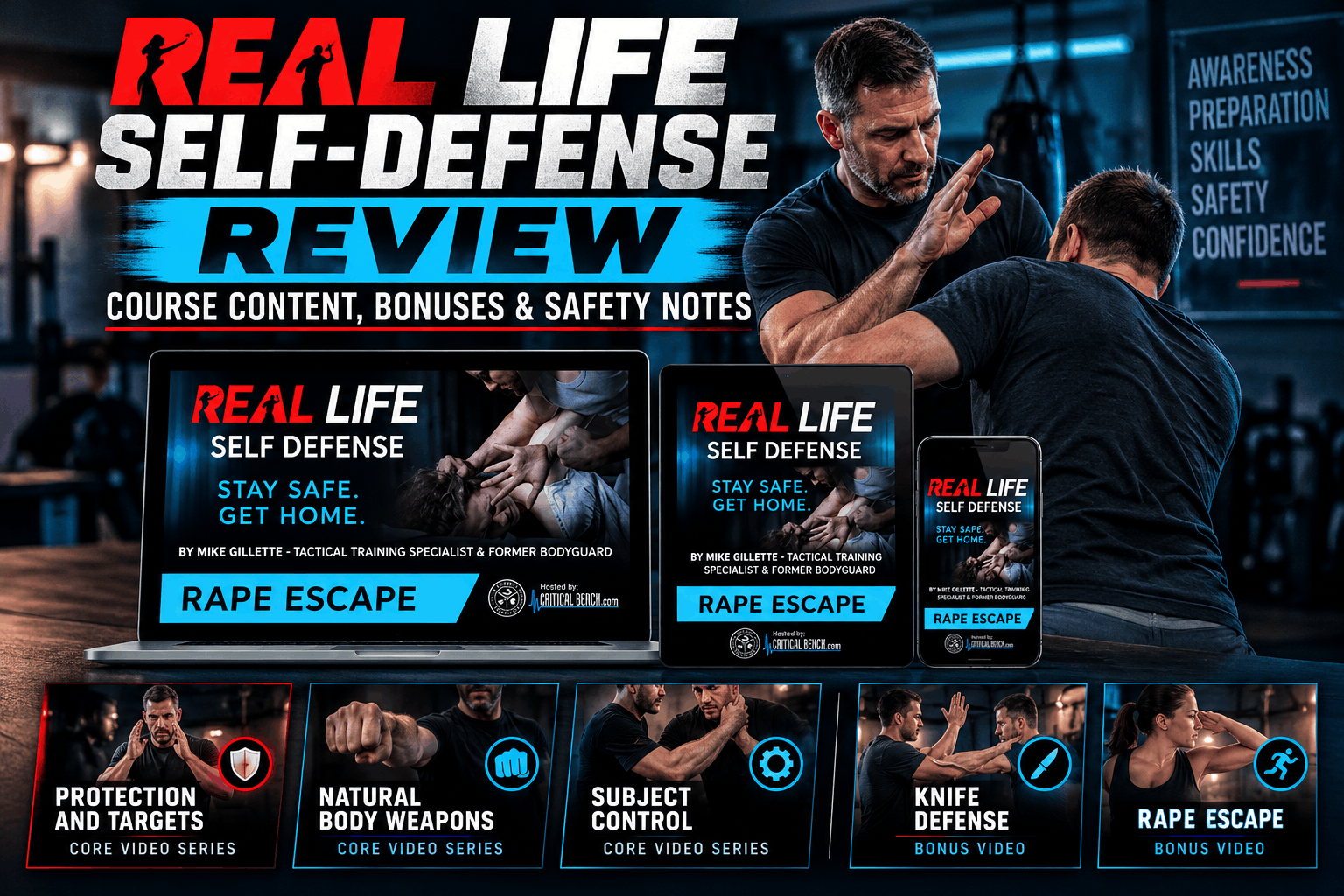
Real Life Self-Defense Program review covering the advertised course modules, bonus videos, and safety considerations.
The Real Life Self Defense Program focuses on mental preparation alongside physical self-defense concepts. It is presented as an online video course that customers can watch on supported devices, rather than an in-person class with an instructor physically correcting their technique. That distinction matters because real-world skills require safe practice, feedback, and realistic expectations. We have reviewed the supplied product copy and available published information, but have not independently tested the course or verified its performance claims.
Research-Based Review:, Based on published product information and research, we have not independently tested this product.
Quick Review: Real Life Self-Defense Program
| Product type | Digital self-defense video training program |
|---|---|
| Instructor named in the offer | Mike Gillette |
| Core video series | Protection & Targets; Natural Weapons of the Body; Controlling the Subject |
| Advertised bonus videos | Real Life Knife Defense and Rape Escape |
| Listed offer price | $39 in the supplied product copy; confirm the checkout total |
| Refund policy | Seller advertises a 60-day money-back guarantee |
| Delivery format | Online videos with access instructions supplied after purchase, according to the seller |
| Physical equipment included? | No physical self-defense equipment is advertised as included |
| Independent testing | Not conducted for this review |
What Is the Real Life Self Defense Program?
The Real Life Self Defense Program is marketed as an at-home educational course for people who want to learn about situational awareness, mental preparation, and physical responses to potential threats. Its sales copy emphasizes simple, memorable techniques and presents the material as an alternative to spending years learning a martial art.
The course is associated with tactical trainer Mike Gillette. The promotional materials describe his background in tactical training, security, and instruction. We have not independently verified every credential or career claim listed on the sales page, so readers should distinguish the seller’s biography from independently confirmed qualifications.
The overall approach combines awareness and decision-making with physical instruction. These are relevant subjects in personal-safety education, but the course’s strongest claims—such as mastering techniques in a matter of hours or reliably handling any kind of attacker—should not be treated as established results.
Inside the Three Core Video Series
According to the product copy, the Real Life Self Defense Program is organized into three main sections. Each covers a different aspect of the seller’s training approach.
1. Protection & Targets
This series is advertised as an introduction to defensive preparation, awareness, positioning, and understanding how situations can develop. The sales copy also discusses responding to common physical threats and avoiding mistakes under pressure.
For a beginner, the value of this section depends on how clearly the instructor explains the concepts and how responsibly the viewer practices them. Reading or watching material about a physical technique does not establish that it can be used effectively in a stressful real-world situation.
2. Natural Weapons of the Body
The second series focuses on the body’s movement and physical responses, including striking concepts and the use of different parts of the body in self-defense. The seller presents these as techniques that do not require a person to be an experienced martial artist.
Physical techniques can carry a risk of injury to both people involved. Viewers should avoid practicing forceful movements on an unwilling or untrained partner and should seek qualified supervision when learning techniques that could cause harm.
3. Controlling the Subject
The third series is described as covering situations involving grabs, being pinned, and attempts to control a person’s movement. The seller presents the material as a way to understand how to react and create an opportunity to escape.
Results in a real confrontation depend on many factors, including surprise, the environment, physical ability, and whether weapons are involved. The course should not be treated as a guarantee that a viewer can control or defeat an attacker.
What Do the Bonus Videos Cover?
The supplied product copy advertises two additional video series with the main course.
Real Life Knife Defense
This bonus is presented as educational material about knife-related threats and the importance of recognizing the danger involved. Knife confrontations are particularly hazardous, and even trained people can be seriously injured. Do not assume that a video course can make disarming an armed person safe or reliable. Prioritizing distance, escape, and emergency assistance is generally safer whenever possible.
Rape Escape
The Rape Escape bonus is marketed as material related to responding to sexual assault threats. Its subject is sensitive, and it is important to state clearly that sexual violence is never the victim’s fault. No self-defense technique can guarantee prevention or escape, and survivors should never be blamed for how they responded during an assault.
Readers considering this material should view it as supplementary education, not a substitute for qualified instruction, professional support, or local emergency resources. The presence of a bonus video does not establish that its promised outcomes are guaranteed.
Important safety note
Do not rely on online videos as your only preparation for violence. Prioritize awareness, avoidance, de-escalation, leaving dangerous situations when possible, and contacting emergency services. Weapon-related confrontations can be life-threatening. If you practice physical skills, use qualified supervision and follow applicable laws.
Does the Course Deliver What the Sales Page Promises?
The Real Life Self Defense Program sales page makes strong claims about how quickly ordinary people can learn techniques and how effectively the methods can work against different attackers. It also includes stories about training sessions and testimonials attributed to customers and other individuals.
These statements are part of the promotional material. We did not independently test the course, observe the reported training sessions, or find controlled evidence demonstrating that customers can reliably master the techniques within the advertised timeframes. Testimonials can describe individual experiences, but they do not establish typical results for all purchasers.
It is reasonable to expect an online course to explain concepts and demonstrate movements. It is not reasonable to assume that watching the lessons once will make someone prepared for every type of confrontation. Physical skill depends on practice, feedback, individual ability, and the circumstances in which a skill is needed.
For that reason, the Real Life Self Defense Program is best assessed as an instructional product rather than a proven guarantee of personal safety. Buyers should be cautious about claims that suggest a person can become fully prepared for any attack in only a few hours.
Price and 60-Day Money-Back Guarantee
The supplied sales copy lists the Real Life Self Defense Program at a promotional price of $39 and shows a stated regular price of $99. These are seller-provided price claims. We could not independently confirm the live checkout price, so check the final order page for the amount charged and any additional terms.
The seller advertises a 60-day money-back guarantee. Before ordering, read the current terms and confirm the process for requesting a refund. Keep your purchase receipt and confirmation email in case you need to contact customer support.
Also check the checkout page carefully for any optional add-ons or recurring charges. The supplied product copy describes the course as a digital video program, but the final payment page is the appropriate place to confirm the exact transaction terms.
Pros and Cons
Potential Advantages
- The advertised course is divided into three core video series.
- The material addresses awareness and mental preparation as well as physical concepts.
- Two additional video bonuses are advertised with the package.
- The online format may suit people who prefer to study at home and review lessons at their own pace.
- The seller states a 60-day refund period, subject to the applicable terms.
Limitations to Consider
- The course’s strongest effectiveness claims have not been independently verified in this review.
- Online videos cannot provide the same physical feedback as supervised, in-person training.
- Weapon-defense and assault-related situations carry serious risks that a video cannot remove.
- The instructor credentials and customer stories in the sales copy have not all been independently verified.
- The current checkout price and any additional billing terms should be confirmed before purchase.
Who Might Consider This Course?
The Real Life Self Defense Program may interest adults looking for introductory self-defense education in a digital format. It could be useful for people who want to explore personal-safety concepts before deciding whether to attend an in-person class.
It is not a substitute for supervised practice, personalized instruction, or emergency planning. Anyone seeking practical skills should consider a qualified instructor who can observe their technique, correct mistakes, and teach appropriate decision-making under controlled conditions.
People looking for reliable safety preparation may also benefit from learning about de-escalation, planning routes and exits, improving home security, and identifying local support and emergency resources. These steps can complement physical training without relying on the promise that a single course can handle every situation.
What to Check Before Ordering
- Confirm that the checkout page lists the core series and both advertised bonus videos.
- Verify the total payment and check for optional add-ons or recurring billing.
- Read the full 60-day refund policy and save the order confirmation.
- Keep realistic expectations about what digital instruction can teach without feedback.
- Do not rely on testimonials or dramatic marketing statements as proof of guaranteed outcomes.
- Consider qualified in-person instruction if your goal is to develop and practice physical skills.
Review the Course Details
Check the current course contents, checkout price, and refund terms before deciding whether this digital training program suits your needs.
Final Verdict
The Real Life Self Defense Program is advertised as a digital course with three core video series and two bonus videos covering knife defense and sexual-assault escape concepts. The supplied sales copy lists a $39 offer and a 60-day money-back guarantee, although buyers should confirm current pricing and terms at checkout.
The course may be worth examining for people interested in introductory personal-safety education. However, its strongest promises about mastering techniques quickly or reliably handling any attacker have not been independently substantiated in this review. A video program cannot guarantee safety or replace supervised practice.
Our assessment: Treat this as an educational resource, not a promise of guaranteed self-defense ability. If you decide to buy, read the checkout terms carefully and pair any online learning with realistic safety planning and qualified instruction where appropriate.
Frequently Asked Questions
Can I review the lessons before practicing physical movements?
Yes. Reviewing instructional material first can help you understand the terminology and the instructor’s explanations. For movements that could cause injury, seek qualified supervision rather than attempting forceful practice based only on a video.
Can this program replace an in-person self-defense class?
It should not be assumed to replace one. An in-person instructor can observe technique, correct errors, adapt exercises, and supervise practice—things a prerecorded video cannot do directly.
What should I do if a self-defense lesson makes me feel unsafe or distressed?
Pause the lesson and do not force yourself to continue. Choose a learning environment that feels safe, and consider support from a qualified instructor or an appropriate professional if the material brings up distressing experiences.
How can I judge whether a self-defense claim is credible?
Look for clearly described methods, qualified independent assessment, realistic limitations, and evidence that can be reproduced. Be cautious of claims that promise universal success or suggest that a short video course guarantees survival in every situation.
About the Author