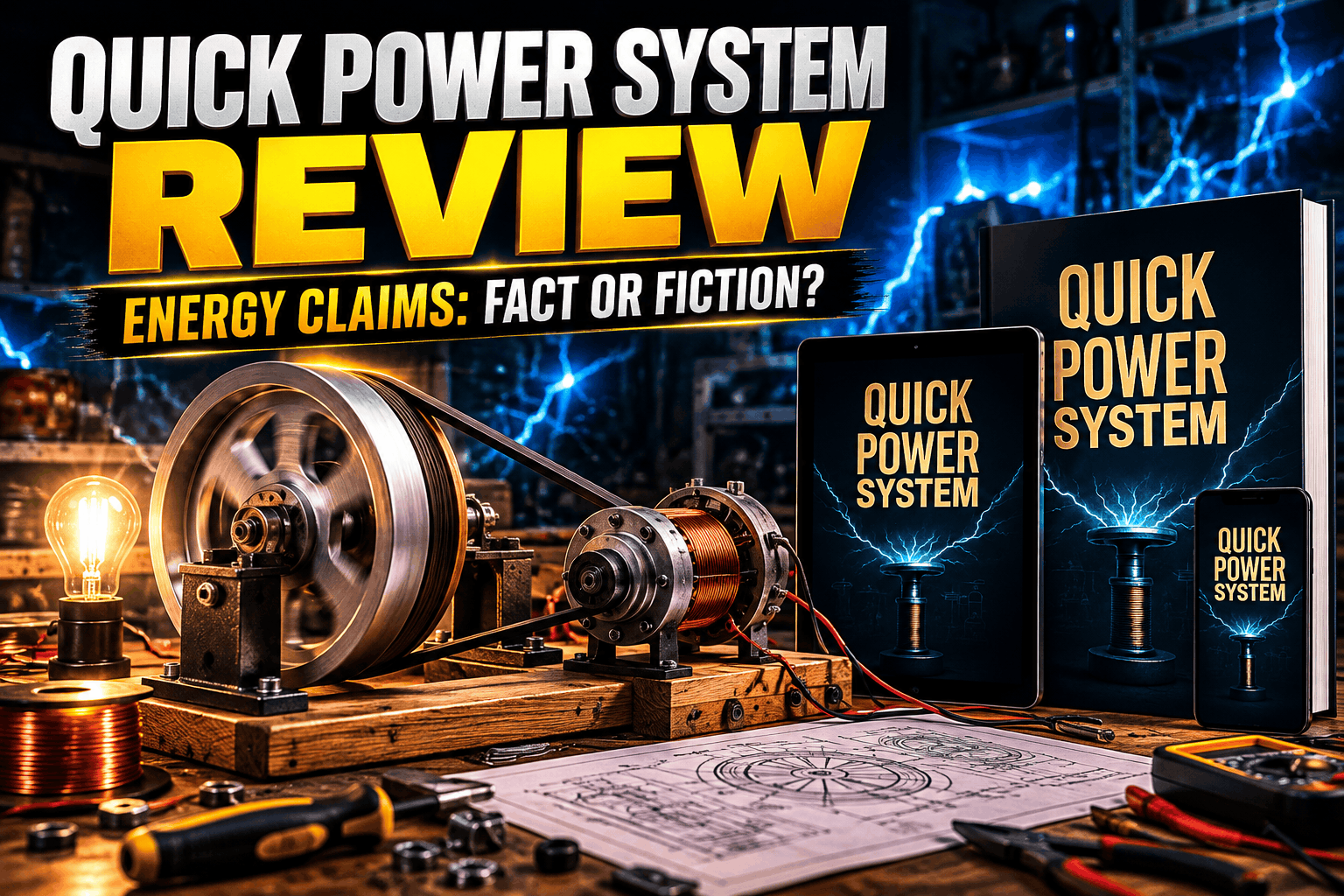
Quick Power System Review: examining the DIY guide, energy claims, and practical limitations.
Quick Power System is marketed as a DIY energy guide that claims to show buyers how to build a home power device using commonly available materials. The sales page promises lower electricity bills and backup power during outages. But does this downloadable guide offer a realistic energy solution, or do its biggest claims go beyond what has been demonstrated? This Quick Power System review examines the product, price, included materials, potential risks, and important scientific limitations before you buy.
If you’re researching the Quick Power System because you’re concerned about rising utility bills or want more reliable emergency power, it’s important to understand what you actually receive. The offer is for digital instructions and plans—not a ready-to-use generator. The advertised savings and continuous-power claims have not been independently verified in the material reviewed for this article.
Research-Based Review:, Based on published product information and research, we have not independently tested this product.
Quick Review: Quick Power System at a Glance
| Product | Quick Power System |
|---|---|
| Product type | Digital DIY guide and plans |
| Listed price | $49 |
| What is included | Step-by-step guide, illustrated blueprints, and materials list, according to the seller |
| Construction materials | Purchased separately; the seller’s story mentions a build costing just under $120 |
| Guarantee | 60-day money-back guarantee, as advertised |
| Support | Lifetime email support is claimed by the seller |
| Independent performance testing | Not established by the materials reviewed |
Price, guarantee, and included materials should be confirmed on the checkout page before purchase. Construction costs are additional and may vary.
What Is Quick Power System?
Quick Power System is presented as a do-it-yourself energy project for people interested in home power, energy independence, and emergency preparedness. Rather than shipping a physical machine, the seller provides a digital package intended to explain how to assemble a device from separate components.
The sales material describes a design involving rotational motion and a low-friction mechanism. It compares the concept with regenerative braking in electric vehicles and claims that the design can keep producing useful electricity with little or no ongoing input. However, the material reviewed does not provide independently verified measurements demonstrating that the proposed device can continuously power household appliances or eliminate electricity bills.
For that reason, Quick Power System is best approached as an unverified DIY energy project—not as a proven replacement for a generator, a battery backup system, or a professionally designed home energy installation.
What Do You Get With Quick Power System?
According to the sales copy, a purchase includes the following digital resources:
- Step-by-step guide: Instructions intended to walk readers through the proposed construction process.
- Illustrated blueprints: Diagrams that are supposed to explain the layout and assembly of the device.
- Materials list: A list of components buyers may need to source independently.
- Digital access: The sales page describes access through an online members’ area.
- Email support: The seller advertises ongoing support for questions about the instructions and parts.
These are descriptions from the seller, not a confirmation that the design will deliver the advertised electrical output. The product images are illustrative, and the seller explicitly states that the product is digital. You should not expect a completed generator, tools, electrical components, batteries, or professional installation to arrive with your order unless the checkout terms specifically say otherwise.
How Is Quick Power System Supposed to Work?
The product’s explanation centers on a rotating mechanism that supposedly converts motion into electricity. The sales page draws a comparison with regenerative braking in electric cars, where motion can be converted into electrical energy during deceleration.
Regenerative braking is real, but it does not create energy from nothing. A vehicle’s moving energy is converted and recovered during braking; the energy originally comes from the vehicle’s power source and motion. Likewise, a flywheel can store energy supplied to it and return some of that energy later, but generating electricity extracts energy from the spinning wheel and slows it down.
The U.S. Department of Energy explains that a flywheel is accelerated by expending energy, then connected to a generator to recover some of that stored energy. Real systems have losses, so they cannot continually return more energy than they receive. Read the Department of Energy’s explanation of flywheel storage.
The Quick Power System sales material does not establish, through independent test data, a complete energy balance showing where the device’s ongoing input energy comes from, how much electricity it produces, or whether it can sustain household loads. Without such evidence, the claim of continuous self-powering operation should be treated cautiously.
Quick Power System Energy-Savings Claims: What Is Verified?
The seller promotes substantial reductions in electricity bills, including claims of savings of 60% or more and, in some passages, eliminating the bill entirely. The page also uses customer stories and a personal narrative to support its claims.
Those stories may help explain the seller’s pitch, but they are not a substitute for independent testing. The material reviewed did not establish a third-party laboratory report, a reproducible output test, a certified power rating, or a measured comparison of electricity consumption before and after using the device.
Before relying on Quick Power System for meaningful savings, look for evidence such as:
- Independent testing that identifies the exact device and construction configuration.
- Measured input and output power over a clearly stated period.
- Continuous operation results under a defined electrical load.
- Documentation of safety protections, output voltage, current, and applicable certifications.
- A transparent calculation showing how the claimed bill savings were measured.
Until that evidence is available, don’t build your household budget around the promised savings. If your main goal is lower electricity costs, established measures such as reducing energy waste, improving insulation, and using appropriately sized, tested equipment are more dependable starting points.
Quick Power System Price and Total Cost
The updated product information lists Quick Power System at $49. The sales copy says that the guide and plans are digital, so the purchase price does not include a finished power unit.
The seller’s personal story mentions spending just under $120 on parts for a build. That is an anecdotal estimate, not a verified bill of materials or a guaranteed construction budget. Your actual total could be higher if components, tools, electrical protection, replacement parts, testing equipment, or professional help are required.
Before ordering, calculate the complete potential cost:
- The $49 guide price.
- All components and materials required by the plans.
- Tools or measuring equipment you do not already own.
- Suitable electrical protection and a safe enclosure.
- Inspection or professional installation costs, if applicable.
A low initial price does not necessarily make an unverified design a cost-effective power solution. Compare the full expected cost with proven backup-power options that provide published ratings, safety documentation, and clearly specified capacity.
Pros and Cons of Quick Power System
Potential Pros
- Relatively low entry price: The listed digital-guide price is $49.
- DIY learning format: Blueprints and written instructions may appeal to readers who enjoy studying mechanical projects.
- Parts list included: The seller says the package identifies materials needed for construction.
- Advertised refund period: A 60-day money-back guarantee is stated in the offer; review the actual terms before buying.
- No physical shipment expected: Buyers can understand upfront that the core purchase is digital information.
Cons and Concerns
- No completed generator included: You receive a digital product, not a ready-to-use power source.
- Major performance claims remain unverified: The reviewed materials do not establish independent proof of the advertised savings or continuous output.
- Additional expenses: Materials, tools, and safety equipment are separate costs.
- Technical and electrical risks: Building and connecting a homemade electrical device can cause shock, fire, equipment damage, or other hazards.
- Inconsistent expectations: The sales page alternates between very large bill savings and claims of powering essential household equipment without supplying sufficient independent test results.
Is Quick Power System Beginner-Friendly?
The seller says the instructions are suitable for beginners and that construction can be completed in several hours or over a weekend. That is a marketing claim, not a verified estimate for every buyer or build.
Even if the instructions are easy to follow, building an electrical device safely requires more than assembling parts. Readers need to understand the ratings of components, insulation, grounding, overcurrent protection, heat management, and the risks associated with moving mechanical parts. Beginners should not assume that a guide’s simplicity claims make an untested device safe for household use.
If you are new to electrical projects, consider starting with a commercially manufactured, safety-certified low-voltage educational kit. Do not connect a homemade device to household wiring or the utility grid without a qualified professional and appropriate approvals.
Can Quick Power System Be Used for Emergency Backup Power?
Quick Power System is marketed to people concerned about blackouts and energy independence. However, the available product information does not establish a verified continuous power rating, runtime, battery capacity, or tested ability to operate a refrigerator, heating system, medical device, or other essential load.
That makes it unsuitable to rely on as your only emergency power plan based on the evidence reviewed. For outage preparedness, compare tested portable power stations, properly installed standby generators, or solar-plus-battery systems. Choose equipment with a documented wattage rating, adequate runtime, suitable connectors, and manufacturer safety instructions.
Safety note: Never operate fuel-burning generators indoors or in enclosed spaces. Never connect a generator to home wiring through an ordinary wall outlet. Use proper transfer equipment installed by a qualified electrician, and follow the equipment manufacturer’s instructions.
Quick Power System Refund Policy
The product information provided for this review advertises a 60-day money-back guarantee. The sales page says buyers can request a refund if dissatisfied. However, the exact conditions, required steps, and processing time should be confirmed from the current checkout terms and order confirmation.
Before purchasing, save a copy of the guarantee and support details. Keep your receipt and note the deadline for submitting a request. A refund promise reduces some purchase risk, but it does not prove that the device works or that construction expenses will be reimbursed.
Who Should Consider Quick Power System?
Quick Power System may interest people who enjoy reading DIY plans and exploring unconventional mechanical-energy concepts. Even so, it should be approached as an unverified educational project rather than a proven route to free electricity.
It is a poor fit for anyone who needs dependable backup power immediately, expects a physical generator to be delivered, or plans to make major financial decisions based on claims of eliminating utility bills. If you choose to investigate it, verify the technical details first and avoid spending money on components until you have reviewed the plans and assessed the risks.
Where to Check Quick Power System Details
The workbook lists the product’s sales page at the link below. I attempted to open the exact URL, but it was not accessible through the browser used for this review. Therefore, the current checkout details and complete live terms could not be independently confirmed.
Before ordering, verify the final price, the digital items included, refund conditions, support contact information, and whether any recurring charges apply.
Review the Offer Carefully
Check the current price, digital contents, and refund terms before deciding whether this DIY guide fits your needs.
Affiliate Disclosure: This article contains an affiliate link. If you purchase through it, we may earn a commission at no additional cost to you. This does not change our commitment to distinguishing seller claims from independently verified evidence.
Final Verdict: Is Quick Power System Worth It?
This Quick Power System review finds that the product is a $49 digital guide marketed around DIY electricity generation and lower utility bills. The advertised package includes instructions, blueprints, and a materials list, but buyers must source the physical components and undertake any construction themselves.
The biggest concern is the gap between the sales promises and the evidence available. The claims of continuous self-powered operation, very large electricity-bill reductions, and reliable household backup power are not established by independent test data in the material reviewed. Real regenerative systems and flywheels recover or store energy supplied from another source; they do not create unlimited energy.
Our recommendation: Do not buy Quick Power System expecting guaranteed free electricity, zero bills, or dependable emergency power. If you are interested in it as an experimental DIY learning resource, first inspect the actual plans, verify the refund terms, estimate the full build cost, and get qualified safety advice before constructing or connecting anything. For practical household backup power, prioritize tested equipment with published specifications.
Frequently Asked Questions
Is Quick Power System a physical generator?
No. The sales material describes Quick Power System as a digital product containing instructions and plans. Physical components and construction are separate, and the guide should not be confused with a generator that arrives ready to use.
How much does Quick Power System cost?
The updated workbook lists the price as $49. The seller’s story mentions a build costing just under $120 in parts, but that is not a guaranteed total. Confirm the checkout price and budget separately for components, tools, and safety requirements.
Can Quick Power System eliminate an electricity bill?
The seller advertises substantial savings, including claims that a bill could be reduced to zero. Those results have not been independently verified in the materials reviewed, so buyers should not rely on them as expected outcomes.
Does Quick Power System include a money-back guarantee?
The offer advertises a 60-day money-back guarantee. Review the current terms, save your purchase confirmation, and verify the refund procedure and deadline before ordering. A guarantee is not evidence that the energy-performance claims are valid.
About the Author