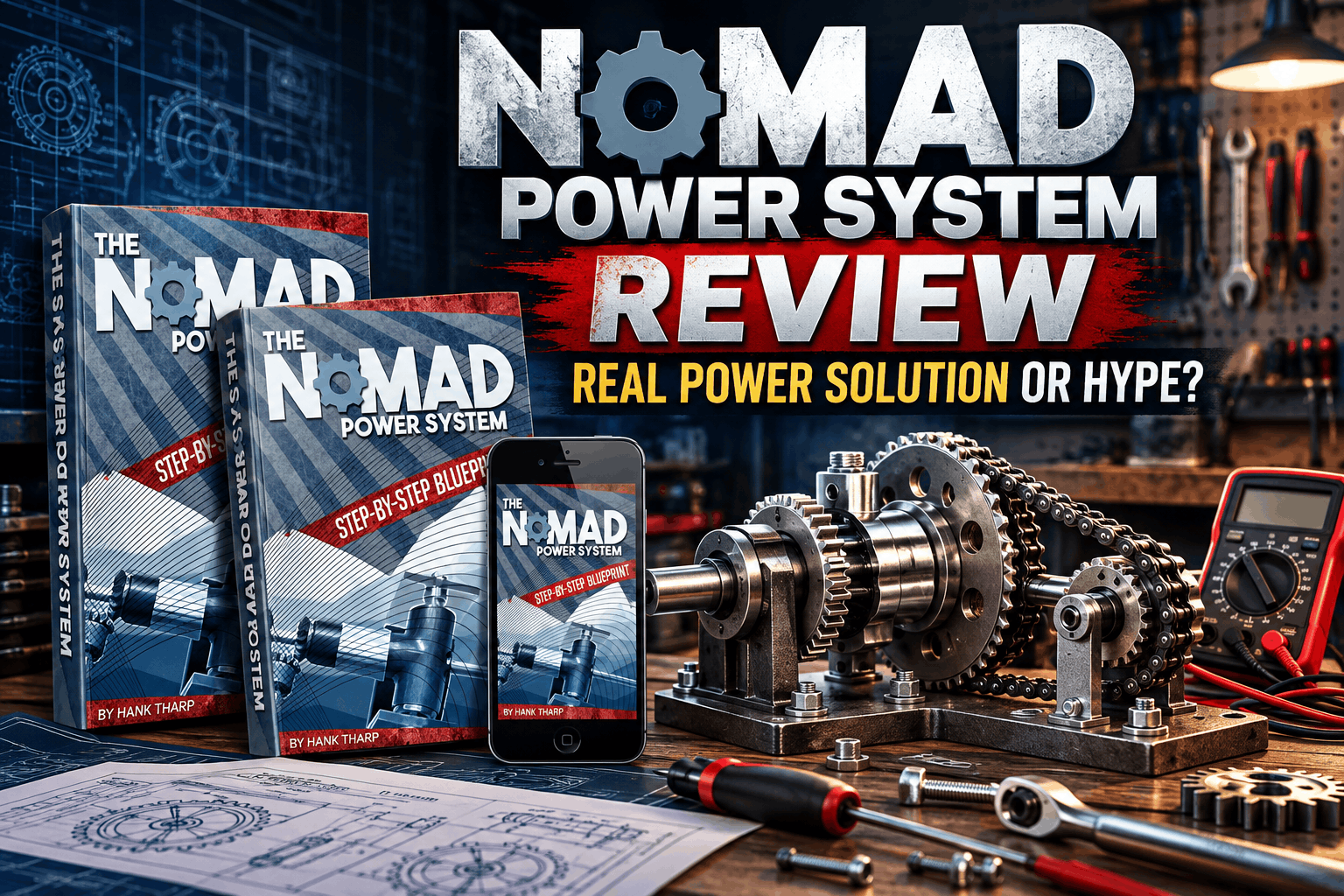
A review of the NOMAD Power System digital blueprints, advertised generator design, and energy-saving claims.
NOMAD Power System is a digital DIY blueprint package promoted as a way to build a homemade generator and reduce dependence on conventional electricity. The sales page promises step-by-step instructions, a parts list, and a design that the seller claims can power household appliances. But can it really deliver the advertised results, and is the package worth buying?
In this NOMAD Power System review, we’ll examine the advertised contents, price, construction costs, refund policy, potential advantages, and important technical questions. We’ll also distinguish the seller’s claims about electricity savings from what has actually been independently established.
Research-Based Review:, Based on published product information and research, we have not independently tested this product.
NOMAD Power System: Quick Review
| Product Name | NOMAD Power System |
|---|---|
| Product Type | Digital DIY generator guide and blueprints |
| Listed Price | $49 according to the product workbook; verify the current checkout price |
| Advertised Materials Cost | Approximately $208, according to the sales copy; actual costs may vary |
| Refund Policy | Advertised 60-day money-back guarantee; check the current terms |
| What’s Included | Digital manual, blueprints, illustrated instructions, and parts list, according to the sales copy |
| Physical Generator Included? | The product is described as digital; a finished generator is not confirmed as included |
| Independent Testing | Not performed for this review |
Our initial assessment: The blueprints may interest DIY enthusiasts, but the available information does not independently establish that the proposed design produces excess energy or delivers the advertised electricity-bill savings.
What Is the NOMAD Power System?
The NOMAD Power System is marketed as a downloadable guide that explains how to assemble a homemade power-generating device. The seller describes a mechanical design involving components such as sprockets, a stainless-steel shaft, ring gears, and pinions.
According to the promotional story, the creator developed the design with help from a mechanical engineer after becoming concerned about electricity costs and power outages. The product is presented as a simplified version of that design, with instructions intended to make construction more accessible to people without extensive technical experience.
It is important to understand that the NOMAD Power System is advertised as a digital information product rather than a ready-to-use generator delivered to your home. Buyers should expect to review the plans and source the required components themselves unless the current offer explicitly states otherwise.
The seller claims that the design can power a range of household appliances and reduce dependence on the electrical grid. However, the available promotional material does not provide independently verified performance measurements demonstrating those results.
What Do You Get With the NOMAD Power System?
The supplied sales copy describes a downloadable package intended to guide buyers through the proposed construction process. The advertised contents include:
- Step-by-step manual: Instructions intended to explain the proposed build from start to finish.
- Blueprints and schematics: Diagrams that the seller says show how the device is assembled.
- Illustrated instructions: Visual guidance intended to help readers follow the construction steps.
- Materials and parts list: A list of components needed for the project.
- Tool guidance: The sales copy says the package explains the tools needed and how to use them.
- Advertised customer support: The seller promotes ongoing email support. Check the current offer terms to confirm the exact arrangement.
The available materials do not establish the full technical completeness of the guide or verify that following the plans will produce the advertised electrical output. We have not independently examined the complete downloadable package or constructed the device.
Before buying the NOMAD Power System, review the current package description and confirm exactly which files, diagrams, support services, and other materials are included.
How Is the NOMAD Power System Supposed to Work?
The sales page describes a mechanical conversion principle involving rotational movement. It claims that movement in different directions can be converted into a more consistent one-way rotation and then used to produce electricity.
Mechanical systems can indeed convert and transmit motion. Gears, shafts, sprockets, and pinions are commonly used to change rotational speed, direction, and torque. These mechanisms can be useful parts of machines and generators.
However, changing the direction or speed of rotation does not create additional energy. A gear system can trade speed for torque, but practical systems also experience friction and other losses. A generator still needs an energy source to maintain motion and produce electrical output.
The sales copy claims that the NOMAD Power System can generate substantially more power than it receives and use that output to keep itself running. We have not found independently verified measurements establishing this claim for the specific design being sold.
A meaningful technical assessment would need to measure the complete system’s energy input and electrical output under a sustained load. It would also need to account for starting energy, mechanical losses, electrical losses, and any external source of power.
Without such evidence, the advertised mechanism should be treated as a proposed design rather than a proven source of continuous, self-sustaining energy.
Can the NOMAD Power System Really Generate Free Electricity?
The promise of free electricity is one of the central selling points of the NOMAD Power System. The sales page suggests that the device can power household appliances without conventional fuel and significantly reduce utility bills.
That claim deserves careful scrutiny. The law of conservation of energy states that energy cannot be created from nothing. A generator converts energy from an external source into electrical energy, and some of that energy is inevitably lost through friction, heat, electrical resistance, and other inefficiencies.
A system can lower operating costs when it uses an available energy source efficiently. Solar panels, wind turbines, and conventional generators all have different input sources and operating requirements. None eliminates the need for an energy source.
The available NOMAD Power System sales copy does not provide independently verified test data demonstrating that the device generates more energy than it receives or operates indefinitely without an external input.
To evaluate such a claim, look for independent tests that document the entire setup, measure all energy inputs and outputs, operate the device under a meaningful load, and allow other people to reproduce the results.
Until reliable evidence is available, we cannot confirm that the NOMAD Power System produces free or unlimited electricity.
Can the NOMAD Power System Reduce Your Electricity Bill by 62%?
The sales page advertises electricity-bill reductions of 62% or more and describes substantial savings over time. Those are marketing claims, not results independently verified by this review.
Actual savings depend on how much usable electricity a system produces and how much grid electricity it can reliably replace. Several factors matter:
- Measured output: The device must produce a measurable amount of usable electricity under real operating conditions.
- Household demand: Powering a small radio requires much less energy than running a refrigerator, dishwasher, or air conditioner.
- Operating time: A brief demonstration does not establish that a device can power appliances continuously.
- Construction expenses: The price of the guide is separate from the cost of parts, tools, wiring, and any additional equipment.
- Reliability: A system must work consistently and safely before it can provide dependable savings.
- Electrical requirements: Depending on the design, protective equipment, storage, and power-conversion components may be necessary.
We have not independently tested the NOMAD Power System or verified the sales page’s reported savings. We therefore cannot promise a 62% reduction or any other particular saving.
If reducing your utility bill is the main goal, begin by reviewing your actual electricity consumption and comparing it with independently documented energy-system performance. Do not base a financial decision solely on an unverified promotional percentage.
NOMAD Power System Price: What Does It Cost?
The product workbook lists the NOMAD Power System at $49. The sales copy also advertises a construction-materials cost of approximately $208, although actual expenses may differ.
These amounts cover different things. The $49 figure is the listed price of the digital package, while the approximately $208 figure is the seller’s estimate for building materials. Neither figure should automatically be treated as the complete cost of a working installation.
Depending on the actual design, buyers may need to account for tools, replacement parts, mounting materials, wiring, electrical protection, and any other equipment required for safe operation. The real cost cannot be confirmed without inspecting the complete plans and the components they specify.
The sales page also displays a higher reference price of $149 and promotional discount language. Because promotional terms can change, confirm the final amount at checkout. Check whether the payment is one-time, whether optional products are offered, and whether any additional charges apply.
Before purchasing the NOMAD Power System, consider both the guide price and the potential construction budget. A relatively inexpensive digital package does not guarantee an inexpensive or successful build.
Pros of the NOMAD Power System
Potential Advantages
- Digital delivery: The advertised plans are delivered electronically rather than as a physical book.
- Blueprint-based format: The sales copy describes schematics and a parts list for the proposed project.
- DIY learning opportunity: The topic may interest people who enjoy researching mechanical systems and generator concepts.
- Listed entry price: The workbook lists the guide at $49, allowing prospective buyers to evaluate the initial cost.
- Advertised refund period: The seller promotes a 60-day money-back guarantee, subject to the current terms.
These potential advantages relate to the advertised format and offer. They do not establish that the design works as claimed, that the instructions are technically complete, or that buyers will achieve the advertised savings.
Cons of the NOMAD Power System
Important Limitations
- Unverified performance claims: The advertised energy output and bill savings have not been independently established for this design.
- No independent testing in this review: We have not built the device or measured its electrical performance.
- Construction costs are separate: The digital package does not confirm that building components are included.
- Technical completeness is uncertain: The plans have not been independently assessed for completeness, reliability, or safety.
- Not a ready-made power solution: The offer is described as a digital guide rather than a tested generator.
- Refund terms need checking: The advertised guarantee should be reviewed before purchasing.
Is the NOMAD Power System Easy for Beginners?
The seller presents the NOMAD Power System as a project that people with limited technical experience can build by following the supplied instructions. The package is advertised with blueprints, illustrations, and a materials list.
However, the actual difficulty depends on the design, tools, components, and the builder’s experience. Working with shafts, gears, moving parts, and electrical connections can require careful assembly and an understanding of safety precautions.
We have not constructed the NOMAD Power System, so we cannot verify the claim that it can be assembled within approximately three hours. Beginners should review the actual instructions and component list before committing to the project.
If the design involves unfamiliar electrical connections, exposed moving parts, batteries, or high-current equipment, seek guidance from a qualified professional rather than improvising.
Safety Considerations Before Building a Generator
Important safety note: Experimental electrical and mechanical equipment can cause electric shock, fire, burns, or injury if it is assembled or operated incorrectly.
- Secure shafts, gears, chains, and other moving components before operating the system.
- Keep hands, clothing, hair, and loose objects away from rotating mechanisms.
- Use components rated for the intended voltage, current, torque, and operating conditions.
- Use suitable wiring, fuses, disconnects, and other protective equipment for the design.
- Follow the manufacturers’ instructions for batteries, power supplies, and electrical components.
- Never connect an experimental generator directly to household wiring or the electrical grid without a properly designed, compliant installation.
- Do not depend on an unverified device as the sole power source for critical medical or safety equipment.
- Consult a qualified electrician or engineer if you are uncertain about assembly or electrical protection.
These are general precautions for generator projects. They are not a claim that the NOMAD Power System has undergone independent safety testing.
Does the NOMAD Power System Include a Money-Back Guarantee?
The supplied sales copy advertises a 60-day money-back guarantee. The seller says that customers who are dissatisfied can request a refund during the stated period.
Before purchasing, review the current refund policy and confirm:
- When the 60-day period begins.
- How a refund request must be submitted.
- Whether any conditions or exclusions apply.
- Which support channel handles refund requests.
Keep your order confirmation and any correspondence related to your purchase. We have not independently tested the refund process and cannot guarantee the outcome of a particular request.
Who Should Consider the NOMAD Power System?
The NOMAD Power System may interest people who enjoy DIY projects and want to examine a proposed mechanical generator design. The advertised blueprints and parts list may be relevant to readers who are comfortable evaluating technical instructions and questioning performance claims.
It may not be suitable for anyone who expects guaranteed free electricity, a proven way to eliminate utility bills, or a ready-to-use emergency power system. The available information does not establish those outcomes.
If your primary goal is reliable backup electricity, compare established options such as battery power stations, appropriately sized solar-and-battery systems, or conventional generators. Assess documented output, installation requirements, operating costs, maintenance, and safety features before making a decision.
Where Can You Check the NOMAD Power System Offer?
The product workbook lists the NOMAD Power System at $49 and records an advertised 60-day money-back guarantee. Promotional prices and terms can change, so check the current offer before purchasing.
Confirm the final checkout price, exactly which digital files are included, the refund procedure, and whether there are optional add-ons. Also consider the separate cost of building components before deciding whether the project fits your budget.
Explore the NOMAD Power System Offer
Check the current price, digital package contents, and refund terms before making your decision.
Verify the offer and terms at checkout.
Affiliate Disclosure: This article contains an affiliate link. If you purchase through it, we may earn a commission at no additional cost to you. Affiliate compensation does not verify the product’s technical claims or guarantee any particular result.
Final Verdict: Is the NOMAD Power System Worth It?
Our verdict on the NOMAD Power System is cautious. The product is presented as a digital blueprint package for a DIY generator project, and its advertised manual, diagrams, and parts list may interest people who enjoy exploring mechanical designs.
However, the most significant promises remain unverified. The sales page claims that the system can generate substantial power and reduce electricity bills by 62% or more, but this review has not independently established those results. A mechanical arrangement can change motion and transmit force, but that alone does not create energy or prove that a device can sustain itself without an external input.
The listed $49 guide price is only one part of the decision. Buyers should account for the separate cost of construction materials, inspect the actual plans, and read the refund policy carefully before spending money.
Bottom line: Consider the NOMAD Power System only if you are interested in examining the digital plans and understand that its performance claims have not been independently verified. If you need dependable electricity or predictable bill savings, compare established power systems and look for reproducible performance data before investing.
Frequently Asked Questions
Is the NOMAD Power System a physical generator?
The supplied sales copy describes a digital package containing a manual, blueprints, and a parts list. It does not confirm that a finished generator or all the construction components are included.
Does the NOMAD Power System really generate free electricity?
The seller claims that the design can provide substantial electricity, but we have not independently verified that claim. Establishing continuous power generation requires reliable measurements of all energy inputs and electrical outputs over time.
How much does the NOMAD Power System cost?
The product workbook lists the digital package at $49. The sales copy separately estimates construction materials at approximately $208, but actual costs may vary. Confirm the current checkout price and budget for any additional components.
Is the NOMAD Power System covered by a refund policy?
The supplied sales copy advertises a 60-day money-back guarantee. Review the current policy for the deadline, request procedure, and any applicable conditions before purchasing.
About the Author