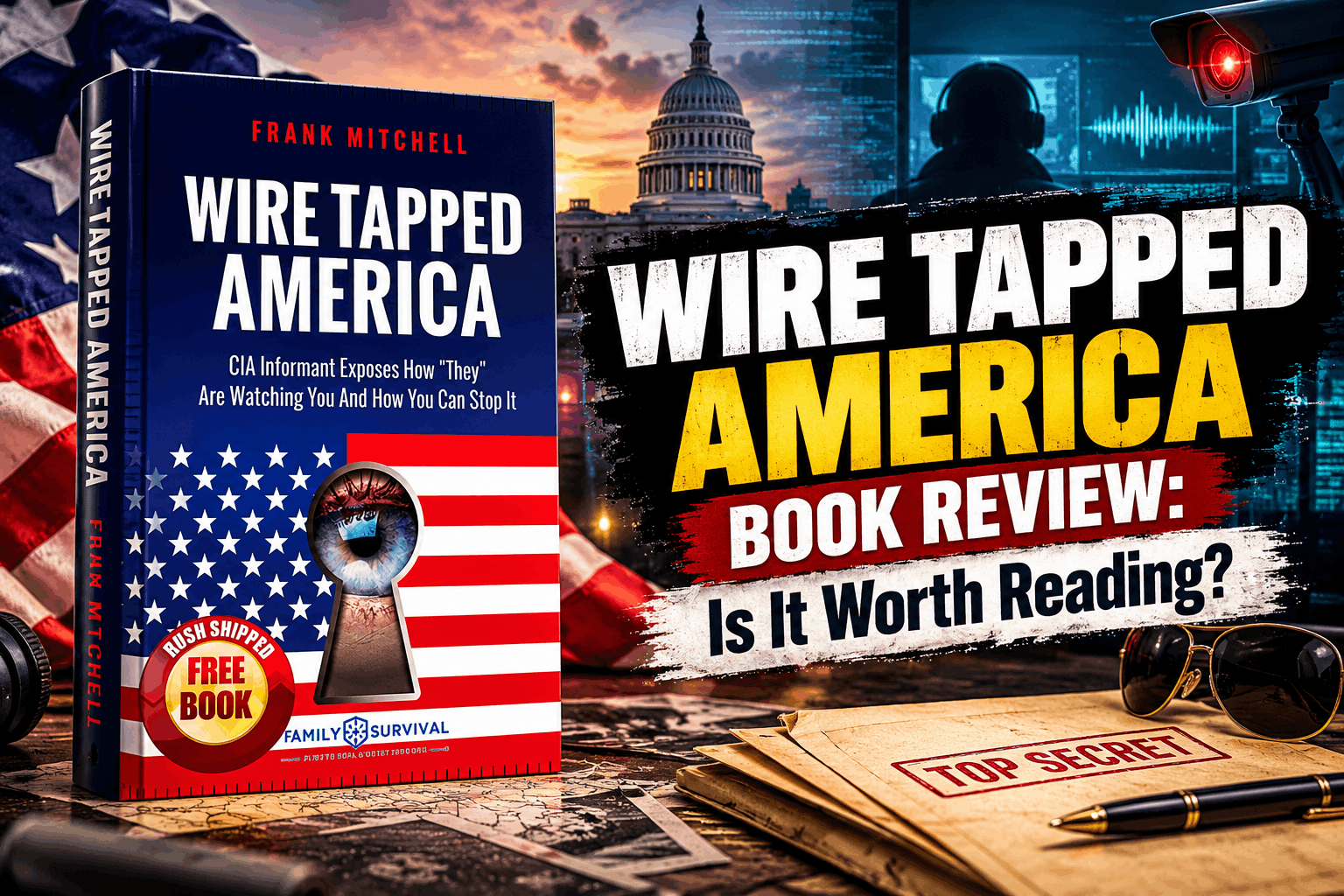
If you’re interested in privacy, surveillance, personal security, or understanding how government and intelligence systems can collect information, Wire Tapped America is a book that takes a direct and controversial approach to the subject.
The book is associated online with Frank Mitchell and is described as an examination of how Americans may be monitored and what individuals can do to reduce their exposure. However, publicly available information about the book is limited, so this review focuses on the book’s stated subject, its preparedness value, and the importance of separating documented surveillance history from claims that require further verification.
Research-Based Review: Based on available product information and public references; we have not independently tested or reviewed the complete book.
Quick Review
- Focus: Government surveillance, privacy, monitoring, and personal awareness.
- Author: Online listings associate the book with Frank Mitchell.
- Positioning: A privacy and surveillance-focused book aimed at readers concerned about monitoring and information collection.
- Best For: Readers interested in privacy awareness, surveillance history, and preparedness from an information-security perspective.
- Main Limitation: Independent information about the book’s authorship, sourcing, and specific claims is limited.
- Our Take: Interesting as a privacy-awareness resource, but readers should independently verify major factual or technical claims.
What Is Wire Tapped America?
Wire Tapped America is presented as a book about surveillance and privacy in the United States. Its central subject is the possibility of communications and personal information being monitored, along with methods intended to help individuals become more aware of their privacy exposure.
That makes the book somewhat different from a traditional survival manual. Instead of focusing on food storage, shelter, medical care, or outdoor skills, its potential preparedness value is primarily information awareness.
For someone building a broader preparedness library, privacy can be a legitimate part of personal security. However, a book dealing with surveillance should be approached carefully. Claims about intelligence agencies, communications monitoring, or specific surveillance programs can vary significantly in quality and evidence.
What Does the Book Cover?
The available descriptions position the book around several connected subjects rather than a conventional emergency-preparedness curriculum.
| Subject | Why It Matters |
|---|---|
| Surveillance awareness | Encourages readers to think about how communications and personal information may be monitored. |
| Privacy | Raises questions about how much personal information people expose through everyday communication. |
| Government and intelligence systems | Provides the broader context for the book’s discussion of monitoring and information collection. |
| Personal security | Connects privacy awareness with a broader approach to personal preparedness. |
Who Is Frank Mitchell?
Public references associate Wire Tapped America with Frank Mitchell and describe him as having intelligence-community experience. However, we could not independently verify a detailed author biography from a strong primary publishing source.
That distinction matters. An author’s claimed background can influence how readers interpret a book, but it should not automatically be treated as proof that every claim inside the book is accurate. Readers should evaluate individual claims based on documentation, primary records, court documents, declassified material, or other credible evidence where available.
Important Reading Note
A book about surveillance can contain a mixture of documented history, interpretation, allegations, and opinion. Those categories should not automatically be treated as equivalent. For important claims, verify the underlying evidence independently.
Is It Useful for Emergency Preparedness?
The answer depends on how broadly you define preparedness.
If your preparedness library is limited to immediate survival skills, this book is not an essential purchase. It does not replace a first-aid guide, emergency food plan, water storage system, fire-starting equipment, or practical outdoor skills.
On the other hand, people who view preparedness as a combination of physical security, information security, privacy awareness, and self-reliance may find the subject worthwhile. Understanding what information you voluntarily expose can be useful even when you are not facing an emergency.
The key is to treat the book as a supplementary privacy-awareness resource rather than as a complete cybersecurity or legal guide.
What We Like
- Unusual preparedness topic: Privacy and surveillance are less commonly covered in traditional survival books.
- Raises awareness: The subject encourages readers to think more carefully about personal information and communications.
- Relevant to modern life: Privacy concerns extend beyond emergencies into everyday digital and communications habits.
- Compact addition to a preparedness library: It can complement, rather than replace, practical survival resources.
Potential Drawbacks
- Limited independent information: Reliable bibliographic and publishing information about the title is difficult to verify.
- Claims require verification: Readers should not automatically accept controversial surveillance claims without checking supporting evidence.
- Not a complete security guide: It should not replace professional cybersecurity, legal, or privacy advice.
- May feel opinion-heavy: Readers looking for a strictly academic history of surveillance may prefer a heavily sourced scholarly work.
Who Should Consider Reading It?
Wire Tapped America may be worth considering if you:
- Want to learn more about privacy and surveillance.
- Are building a preparedness library that includes information security and personal privacy.
- Enjoy investigative or controversial books about government and intelligence topics.
- Are willing to cross-check major claims rather than accepting them automatically.
It may be a poor fit if you want a conventional survival manual, a technical cybersecurity textbook, or a fully documented academic history of U.S. surveillance.
What to Check Before Buying
Because information about this title is relatively limited, take a few minutes to confirm the current listing before ordering.
- Confirm the current price and availability.
- Check the exact edition and format being offered.
- Verify the author information shown on the current listing.
- Look at the available description and determine whether the book’s approach matches what you want to learn.
- If factual documentation is important to you, consider whether the edition provides references or sources that you can independently examine.
Price and Buying Considerations
The product information available to us lists the book at approximately $19.97. Because book prices and availability can change, check the current product page before placing an order.
For a book in this price range, the main question is not simply whether it is inexpensive. The better question is whether its perspective and subject matter match your interests. If privacy and surveillance are already part of your preparedness research, the book may offer an interesting addition. If you are primarily looking for hands-on survival skills, your money may be better spent on a more practical field guide.
Want to Learn More?
Check the current Wire Tapped America listing for the latest price, edition, availability, and product details.
Final Verdict: Is Wire Tapped America Worth Reading?
Wire Tapped America is best viewed as a niche privacy and surveillance book rather than a conventional survival manual. Its subject is relevant to readers who believe preparedness should include awareness of how personal information and communications can be exposed.
The biggest reason to approach the book carefully is the limited independent information available about the title and its specific claims. That does not automatically make the book unhelpful, but it does mean readers should distinguish between documented facts, interpretation, and allegations.
Our verdict: It can be an interesting addition for readers specifically interested in surveillance and personal privacy, but it should be supplemented with well-sourced privacy, cybersecurity, and historical resources. If your main goal is practical emergency preparedness, prioritize hands-on survival resources first.
Frequently Asked Questions
What is Wire Tapped America about?
The book focuses on surveillance, privacy, monitoring, and ways individuals can become more aware of their exposure to information collection.
Who wrote Wire Tapped America?
Public references associate the book with Frank Mitchell, although detailed author and publishing information is limited and should be confirmed against the current edition.
Is Wire Tapped America a survival book?
Not in the traditional sense. It is better described as a privacy and surveillance-focused book that can complement a broader preparedness library.
Are the book's surveillance claims independently verified?
Not all of the book’s specific claims could be independently verified from reliable primary sources available for this review. Readers should check important claims against credible documentation.
Who should read Wire Tapped America?
It is most suitable for readers interested in privacy, surveillance, intelligence topics, and information security as part of personal preparedness.
Is Wire Tapped America worth buying?
It may be worthwhile if surveillance and privacy are subjects you specifically want to explore. For readers looking for practical emergency skills, however, other preparedness books are likely to provide more direct value.
About the Author