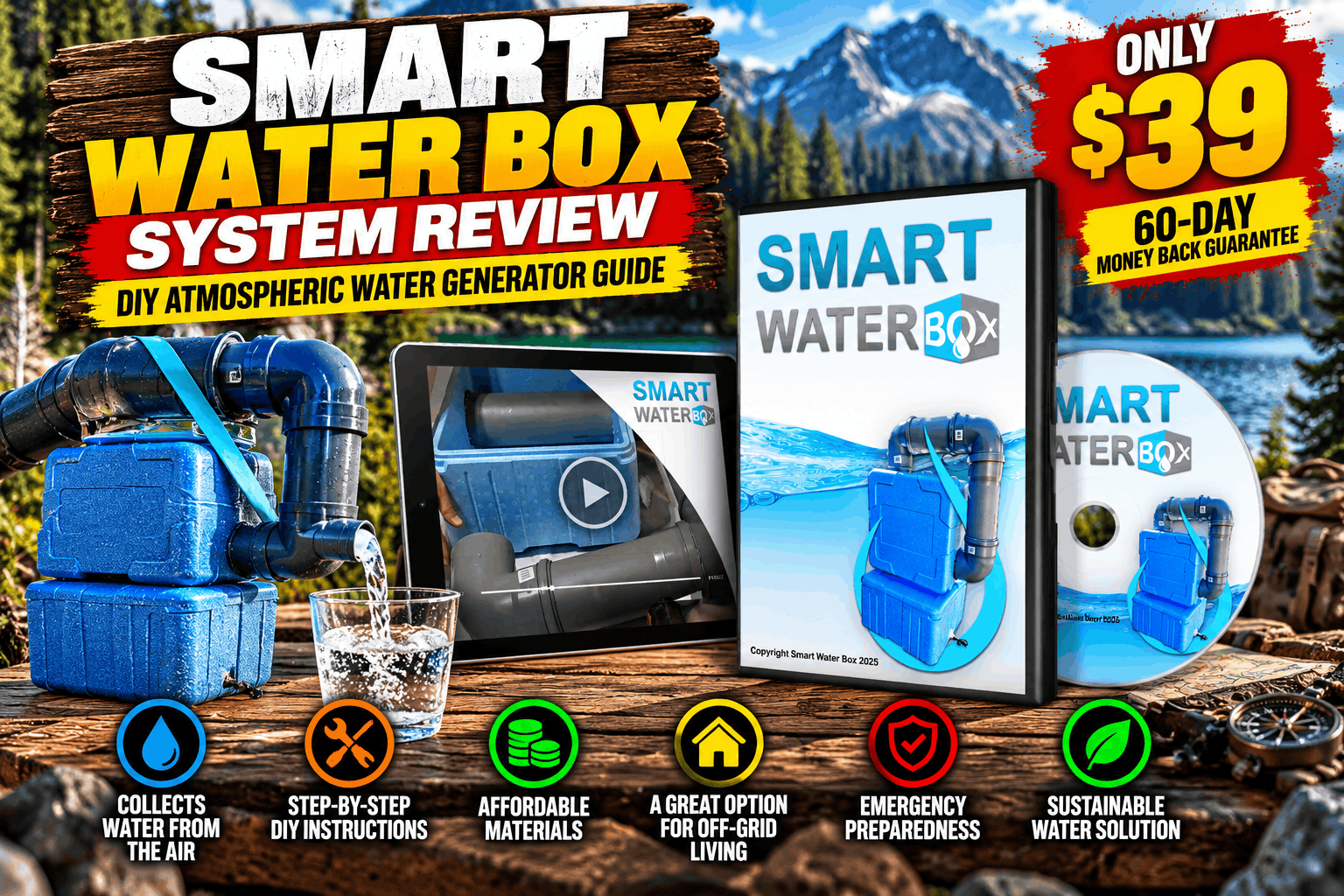
Smart Water Box System review examining the advertised DIY water-generation guide, costs, and practical limitations.
Smart Water Box System is marketed as a digital DIY guide that explains how to build a device intended to collect moisture from the air. It targets people interested in emergency preparedness, off-grid living, and learning about alternative water sources. The product is not described consistently across every sales-page section, so buyers should distinguish the downloadable instructions from a finished, ready-to-use water generator.
The product sheet lists the price at $39 and records a 60-day money-back guarantee. The sales page advertises blueprints, a materials list, step-by-step building instructions, and water-safety and storage guidance. It also promotes bonus resources, although the number of bonuses is inconsistent across page sections. These are seller claims, not independently verified results.
This review looks at what the guide appears to offer, how atmospheric water collection works, potential additional costs, and the limitations buyers should understand before ordering. We have not purchased or built the system, so we cannot confirm its water output, build cost, ease of assembly, or the safety of water produced by following its instructions.
Research-Based Review:, Based on published product information and research, we have not independently tested this product.
Quick Review: Smart Water Box System
| Product type | Digital DIY blueprint and instructional guide |
|---|---|
| Main purpose | Explains a proposed atmospheric water collection build |
| Listed price | $39; confirm the current checkout price |
| Advertised contents | Blueprints, materials list, building instructions, and safety/storage guidance |
| Bonus material | Additional resources advertised; exact count varies across page sections |
| Refund policy | Seller advertises a 60-day money-back guarantee |
| Physical generator included? | The product is presented primarily as a digital guide, not a shipped machine |
| Extra costs | Components, tools, power, maintenance, and water testing may cost extra |
| Independent testing | Not performed for this review |
What Is the Smart Water Box System?
The Smart Water Box System is promoted as a guide for building a device that collects moisture from the surrounding air. Rather than buying a completed appliance, customers are directed to download instructions and use them to plan and assemble their own setup.
The sales page describes blueprints, a materials list, construction instructions, safety notes, water-storage guidance, and troubleshooting information. It also presents the project as accessible to beginners. However, we have not independently examined the complete paid guide, so we cannot confirm how detailed or technically complete the instructions are.
The key distinction is that buying a guide is not the same as buying a working water generator. You may need to source components, use tools, assemble the system, provide electricity for certain parts, and work out an appropriate water-treatment process. Those requirements should be considered before treating this as a low-cost emergency solution.
How Is the Proposed Water Collection Process Supposed to Work?
The concept promoted by Smart Water Box System is based on atmospheric water generation. Air contains water vapor, and under suitable conditions that vapor can condense into liquid water when cooled below its dew point.
- Air intake: Air containing moisture enters the proposed system.
- Cooling: A cooling surface lowers the air temperature enough for moisture to condense.
- Collection: Condensed droplets are directed into a collection container.
- Water treatment: The collected water needs appropriate treatment and hygienic storage before it can be considered for drinking.
This is a real physical process, but actual output is not guaranteed. Temperature, humidity, cooling capacity, airflow, energy consumption, and system design all affect performance. A description of condensation alone does not demonstrate that a particular DIY build can produce enough water for a household.
The seller’s statements about convenient water access should therefore be treated as promotional claims. We found no independent performance test for the specific Smart Water Box System design that establishes its daily output, energy efficiency, or reliability in different climates.
What Does the Guide Advertise?
Based on the product page, the advertised package focuses on teaching the buyer how to plan and construct the proposed system. The listed elements include:
- Blueprints or schematics for the proposed build.
- A materials and tools list.
- Step-by-step construction instructions.
- Safety notes and water-storage guidance.
- Troubleshooting and possible upgrade information.
- Additional bonus resources promoted with the offer.
The sales page also uses phrases such as lifetime support and describes extra survival-related resources. We have not independently verified the scope, duration, or responsiveness of any support service. The sales page’s bonus count also varies across sections, so confirm the precise digital files included in the checkout offer before purchasing.
Potential Advantages
What May Appeal to Buyers
- Practical learning: The guide aims to explain the process and components involved in atmospheric water collection.
- DIY format: A materials list and construction instructions may help readers plan a hands-on project.
- Preparedness interest: Learning about alternative water technologies can complement a wider emergency plan.
- Digital access: The product is marketed as a downloadable guide rather than a physical appliance that must be shipped.
- Related resources: The seller promotes additional materials connected to water and survival preparedness.
These are potential benefits of the educational format, not proof that a completed build will deliver a reliable water supply. Buyers should judge the guide on the quality of its instructions and the feasibility of the actual project.
Limitations and Important Buyer Considerations
What to Keep in Mind
- It is a guide, not a ready-made appliance: Buyers should expect to source and assemble the required parts.
- Total cost may exceed the guide price: Components, tools, electricity, and maintenance can add up.
- Output is unverified: The specific design’s daily water production has not been independently established.
- Climate affects results: Available moisture depends on humidity and temperature.
- Power requirements matter: Cooling and airflow components may need electricity, which can complicate off-grid use.
- Water safety needs proper validation: The seller’s description does not replace independent water-quality testing.
- Promotional details vary: Bonus counts and some marketing statements are not consistent throughout the page.
These points are especially important if you are considering Smart Water Box System for emergency planning. A DIY project should not be treated as a dependable primary water source until its output, operating costs, and water quality have been assessed in the conditions where it will be used.
Can Water Collected From Air Be Safe to Drink?
Water-safety note: Condensed water is not automatically safe to drink. Airborne contaminants, construction materials, collection surfaces, reservoirs, and microbial growth can affect water quality.
Do not drink water from a DIY build until the complete treatment process has been appropriately validated and the water has been tested for the relevant contaminants. Basic filtration claims alone do not establish potability.
The sales page refers to safety notes and water-purification guidance, but we have not seen independent laboratory results for water produced by this particular design. The product’s marketing does not establish that the proposed system consistently removes chemical and microbial contaminants.
Anyone considering the project should seek appropriate technical guidance on water treatment and testing. For emergency preparedness, keep a separate supply of reliably stored drinking water and follow local public-health recommendations rather than relying on an untested DIY device.
How Much Could the Complete Project Cost?
The product sheet lists the guide at $39. That is the advertised digital-product price, not necessarily the total price of a completed build. The sales page discusses obtaining parts and claims that the project can be inexpensive, but we have not independently verified its cost estimate.
Before ordering, identify every required component and check local prices. Your budget may need to include cooling equipment, a fan, tubing, fittings, a collection container, filtration and treatment equipment, electricity, replacement parts, and water testing. The final cost will depend on the design and the parts you choose.
It is also worth comparing the estimated running cost with other backup-water options available in your area. Without measured water output and energy consumption, it is not possible to establish that this DIY approach will save money on household water expenses.
Who Might Consider This Guide?
Smart Water Box System may interest DIY enthusiasts who want to learn about atmospheric water collection, readers exploring off-grid technologies, and preparedness-minded buyers who are comfortable evaluating a technical project before building it.
It may be less suitable for someone who needs a working appliance immediately, expects guaranteed daily water production, or does not want to buy parts and carry out assembly. Buyers who cannot test the resulting water should not use the project as their sole source of drinking water.
Buyer Checklist Before Ordering
- Confirm that the checkout page describes a digital guide and lists the files included.
- Check the current price and exact terms of the advertised refund guarantee.
- Confirm the number and names of any bonus resources.
- Review the complete materials list and estimate the total build cost.
- Consider local humidity, temperature, power availability, and realistic water needs.
- Check that the instructions explain safe assembly, maintenance, and water treatment adequately.
- Plan for appropriate water-quality testing before considering the output potable.
- Keep a separate, reliable drinking-water supply for emergencies.
Where to Check the Current Offer
If the project fits your skills and requirements, review the current product details and terms before making a purchase. Do not base your decision solely on claims of unlimited water, universal climate performance, or guaranteed savings.
Review the Current Offer
Check the latest price, included digital materials, and refund terms before ordering.
Final Verdict on Smart Water Box System
Smart Water Box System is marketed as a digital DIY resource for people who want to learn about collecting moisture from the air. Its advertised blueprints, materials list, and construction guidance may appeal to readers who enjoy practical projects and want to explore alternative water technologies.
The main limitation is the difference between learning about atmospheric water generation and having a proven source of safe, dependable drinking water. The underlying condensation principle is real, but the specific design’s output, energy requirements, total build cost, and water quality have not been independently verified in this review.
Our recommendation is to treat Smart Water Box System as an educational DIY guide rather than a guaranteed water-supply solution. Check the complete materials list and current offer terms, estimate the full cost, and plan for appropriate treatment and testing. If your primary goal is emergency readiness, keep a proven backup water supply instead of relying on an untested build.
Frequently Asked Questions
What should I check in the download before buying components?
Look for a complete parts list, clear diagrams, assembly steps, maintenance instructions, and realistic information about power use and expected output. If these details are missing or unclear, contact the seller before investing in materials.
How can I evaluate whether the project is practical for my location?
Consider local humidity and temperature, the availability and cost of electricity, space for the equipment, and your intended water needs. A design that collects some moisture in one environment may perform differently in another.
What should I do if a promised file is missing after purchase?
Save your order confirmation and contact the vendor using the support details provided with the purchase. Identify the missing file and ask for clarification of the package contents.
Should I use the project as my only emergency water plan?
No. Until a completed build has demonstrated adequate output and safe water quality under your conditions, maintain a separate, dependable drinking-water supply and follow local emergency guidance.
About the Author