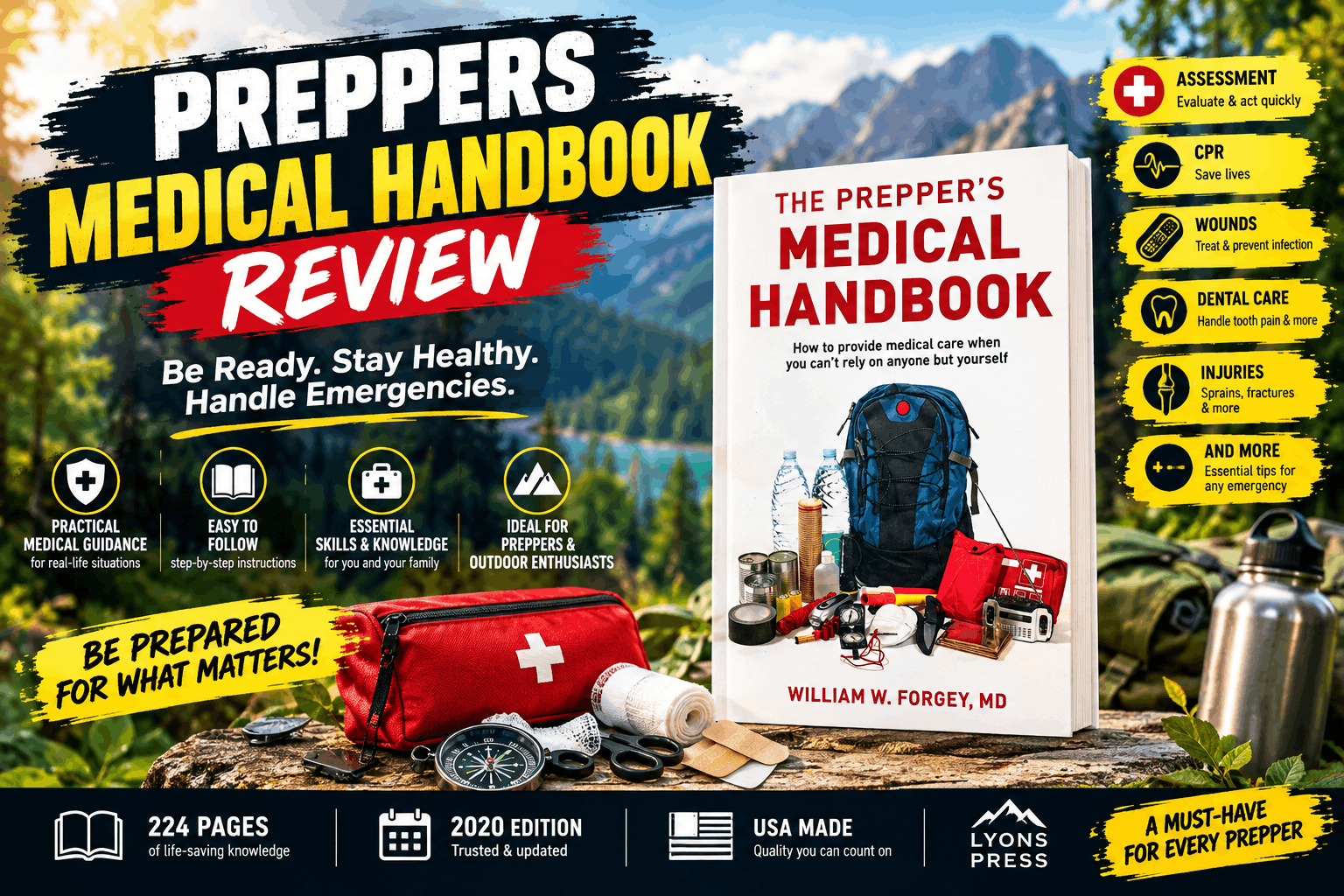
Preppers Medical Handbook: A Practical Guide to Emergency Medical Preparedness?
When a serious emergency disrupts normal services, access to professional medical help may become delayed or difficult. For people who prepare for natural disasters, extended power outages, or remote outdoor travel, understanding basic medical preparedness can be an important part of planning.
The Preppers Medical Handbook by William W. Forgey, M.D., is designed to help readers understand medical assessment, emergency care, supply preparation, and the management of certain survivable medical conditions when normal support systems are unavailable. Rather than being a simple first-aid checklist, it covers a broad range of subjects, including wounds, CPR, dental care, environmental injuries, bites, and off-grid medical supplies.
Listed at $19.95 in the supplied product information, this handbook may interest preparedness-minded households, outdoor enthusiasts, and readers who want to build a more organized medical reference library.
However, reading a medical handbook does not make someone a trained healthcare professional. Some medical situations require immediate professional treatment, and advanced procedures should not be attempted simply because they appear in a book.
In this review, we’ll examine the handbook’s author, subject coverage, practical value, limitations, and who may benefit from adding it to a preparedness library.
Editorial note: This is a research-based book review. We have not independently tested or medically validated the procedures discussed in the publication.
What Is the Preppers Medical Handbook?
The Preppers Medical Handbook is a medical preparedness reference written by William W. Forgey, M.D. It focuses on understanding and preparing for medical situations that may arise when normal emergency services and healthcare access are disrupted.
The publisher describes the book as a resource covering prevention, identification, and long-term management of survivable medical conditions. It also discusses medical supplies, storage considerations, and situations where more advanced medical knowledge may be required.
Its subject matter extends beyond basic cuts and scrapes. The contents include initial assessment, vital signs, CPR, body-system symptoms, dental care, trauma management, orthopedic injuries, bites and stings, infectious disease, environmental injuries, and off-grid medical kits.
This broad coverage is the handbook’s main attraction. Instead of focusing on one particular emergency, it provides readers with a structured introduction to multiple areas of medical preparedness.
Preppers Medical Handbook Specifications
The following table summarizes the product and publication details available from the supplied product information and publisher/retailer listings.
| Specification | Details |
|---|---|
| Book title | The Prepper’s Medical Handbook |
| Author | William W. Forgey, M.D. |
| Publisher | Lyons Press |
| Product type | Physical medical preparedness handbook |
| Listed price | $19.95 |
| Publisher edition information | 2020 edition listing |
| ISBN for 2020 edition | 9781493046959 |
| Page count for 2020 edition | 224 pages |
| Main subject | Emergency and off-grid medical preparedness |
| Topics | Assessment, CPR, wounds, dental care, injuries and more |
| Warranty | Disaster Warranty (verify seller terms) |
| Returns | Easy Returns (verify current conditions) |
Important: A newer publisher listing shows a different edition with a different ISBN and page count. Confirm the exact edition supplied by the retailer before ordering.
Who Wrote the Preppers Medical Handbook?
The handbook is written by William W. Forgey, M.D., whose background includes emergency medicine, wilderness medicine, medical education, and humanitarian work.
The retailer’s author biography describes Dr. Forgey as a former emergency-room physician who also worked in family medicine. It lists experience in wilderness and remote medical care, medical service trips, and outdoor education.
The publisher also identifies him as an emergency physician and wilderness medicine expert.
An author’s professional background is relevant when evaluating a medical reference book, particularly one intended for emergency preparedness. However, credentials alone do not guarantee that every reader can safely perform every procedure described. Readers should distinguish between educational information, basic first-aid knowledge, and medical interventions that require professional training.
What Topics Does the Handbook Cover?
The handbook’s broad subject coverage is one of its most notable features. Its published table of contents includes several areas relevant to emergency and off-grid medical planning.
1. Initial Assessment and Stabilization
The book begins with medical assessment and stabilization. Topics include scene assessment, vital signs, medical history, physical examination, shock, and breathing difficulties. Understanding assessment concepts can help readers become more organized when communicating information to emergency responders. It is not a replacement for recognized first-aid or CPR training.
2. CPR and Cardiac Care
The contents include adult one-rescuer and two-rescuer CPR, cardiac evaluation, and related subjects. These are important emergency-preparedness topics. However, CPR guidance and recommended techniques can change. Readers should also complete current hands-on training from a recognized provider rather than relying exclusively on a printed reference.
3. Body-System Symptoms and Management
The handbook covers symptoms associated with different body systems, including the eyes, ears, nose, mouth, throat, chest, abdomen, and reproductive organs. This section is relevant to readers who want a wider understanding of medical concerns rather than a guide limited to external injuries.
4. Wounds, Trauma, and Orthopedic Injuries
The listed contents include wound care, bleeding wounds, wound closure techniques, infection, inflammation, and bone and joint injuries. These subjects may help readers understand the range of issues that can occur during accidents or outdoor activities. Procedures such as wound closure or other invasive interventions should only be performed by appropriately trained professionals.
5. Bites, Stings, and Environmental Injuries
The book also addresses snakebites, insect stings, aquatic injuries, cold stress, heat stress, lightning, and high-altitude illnesses. This coverage may be especially relevant to people who travel, camp, hike, or spend time in remote locations.
6. Off-Grid Medical Kits and Supplies
Another important subject is the preparation of an off-grid medical kit. The contents include medical supplies, replacement medications, and a reference bookshelf. This can help readers think beyond simply buying a first-aid box. Medical preparedness also involves checking expiration dates, understanding storage conditions, and knowing when professional care is needed.
The topic list is based on the published table of contents; it should not be interpreted as a recommendation to perform medical procedures without appropriate training.
What Makes This Handbook Relevant to Preppers?
Many preparedness plans focus heavily on food, water, power, and shelter. Medical planning is another important area, particularly when emergency services may be delayed.
The Preppers Medical Handbook brings several medical topics together in one reference. Readers can explore basic assessment concepts, emergency situations, environmental injuries, and medical supply planning without collecting multiple unrelated books first.
It may also encourage readers to think about preparedness before an emergency happens. For example, having a medical kit is only one part of preparation. Understanding what is stored, how supplies should be maintained, and when a condition requires professional care also matters.
The book is best approached as a study and reference resource—not a substitute for a doctor, emergency responder, or certified medical training.
Important Medical Safety Note
This handbook is an educational reference. It does not replace professional medical care, emergency services, or recognized hands-on medical training. Never attempt advanced procedures solely because they are described in a book.
Potential Advantages and Limitations
✓ Potential Advantages
- Written by William W. Forgey, M.D., with emergency and wilderness medicine experience.
- Covers multiple areas of medical preparedness in one book.
- Includes assessment, vital signs, CPR, wounds, and environmental injuries.
- Discusses off-grid medical supplies and storage.
- May help readers identify gaps in household preparedness planning.
- Provides a physical reference that does not depend on electricity or internet access.
✕ Things to Consider
- Reading the book does not provide professional medical qualifications.
- Some subjects involve advanced procedures requiring appropriate training.
- Readers should verify that medical guidance aligns with current recognized recommendations.
- Available listings show different publication editions and page counts.
- It cannot replace emergency services, professional diagnosis, or hands-on training.
Who Should Consider Buying This Book?
The Preppers Medical Handbook may be worth considering for people who are building a home emergency library, preparing for extended disruptions, or learning more about wilderness and remote medical preparedness.
It may also interest experienced campers, outdoor educators, and preparedness enthusiasts who want a broader medical reference alongside their existing first-aid supplies.
It may be less suitable for someone who wants a simple, beginner-friendly first-aid manual with only quick instructions for everyday minor injuries. A focused first-aid guide or certified course may be a better starting point for that reader.
Anyone purchasing the handbook should also consider their current level of medical knowledge and whether they need practical training to complement the reading material.
Price, Warranty and Availability
The supplied product sheet lists the Preppers Medical Handbook at $19.95. My Patriot Supply’s product listing also displays this price, although the page’s availability indicators have been inconsistent. Check the latest product page before ordering.
The sheet lists a Disaster Warranty and Easy Returns. These are seller-provided terms, not a guarantee of unlimited coverage. Review the current warranty and return conditions, especially for a printed book.
Check Price & Availability
Interested in adding this handbook to your emergency-preparedness library? Check the current product listing for its price, edition, availability, and seller terms.
Affiliate Disclosure
Survival Essentials may earn a commission if you purchase through the affiliate link above. This comes at no additional cost to you. Our goal is to provide useful, research-based product information and help readers make informed buying decisions.
Final Verdict: Is the Preppers Medical Handbook Worth Considering?
The Preppers Medical Handbook offers broad coverage of medical preparedness, including assessment, CPR, wounds, trauma, environmental injuries, and off-grid medical supplies. Its author, William W. Forgey, M.D., has a background in emergency and wilderness medicine, which is relevant to the book’s subject.
Its biggest advantage is the range of topics gathered in one physical reference. For preparedness-minded readers, it may be a useful addition to a home or outdoor medical library.
However, it should not be treated as a shortcut to medical training. Some procedures require professional qualifications, and emergencies still require appropriate medical services whenever available. The different edition details across listings are also worth checking before purchasing.
For readers who want to expand their medical-preparedness knowledge and understand what to plan for, the handbook may be worth considering at the listed $19.95 price—provided they approach it as an educational reference rather than a replacement for professional care.
Frequently Asked Questions
Who wrote the Preppers Medical Handbook?
The book was written by William W. Forgey, M.D., whose background includes emergency medicine, wilderness medicine, family medicine, and humanitarian work.
What is the main purpose of the handbook?
It is designed to provide information about prevention, identification, and management of survivable medical conditions, particularly when normal emergency support may be unavailable.
Does the book cover basic first aid?
Its contents include assessment, vital signs, wounds, trauma, and other first-aid-related subjects. It also covers more advanced medical topics, so it is broader than a basic first-aid checklist.
Does the Preppers Medical Handbook explain CPR?
Yes. The published contents include adult one-rescuer and two-rescuer CPR. Readers should still obtain current hands-on CPR training from a recognized provider.
Does it cover wound care and injuries?
Yes. Its listed topics include bleeding wounds, wound closure techniques, infection, inflammation, and orthopedic injuries.
Is this handbook suitable for beginners?
It may be useful as a learning reference, but some sections cover technical medical subjects. Beginners should pair reading with recognized first-aid training and should not attempt advanced procedures without appropriate qualifications.
Can this book replace a doctor or emergency medical services?
No. It is an educational reference, not a substitute for professional medical care, emergency services, or clinical diagnosis.
Does the handbook cover off-grid medical supplies?
Yes. The published contents include an off-grid medical kit and replacement medications, along with other preparedness-related material.
Is the Preppers Medical Handbook a physical book or an eBook?
My Patriot Supply’s product Q&A identifies the listed product as a physical copy. Confirm the exact format and edition on the current product page before purchasing.
What is the listed price of the handbook?
The supplied product sheet lists $19.95. Retailer prices and availability can change, so verify the current offer before ordering.
How many pages does the book have?
The publisher’s 2020 edition listing identifies 224 pages. A newer publisher listing shows a different edition with 320 pages, so check the ISBN and edition of the copy being sold.
Is this book useful for camping and wilderness preparedness?
Its coverage of environmental injuries, bites and stings, trauma, and medical supplies may make it relevant to outdoor enthusiasts. It should complement—not replace—appropriate wilderness first-aid training.
About the Author