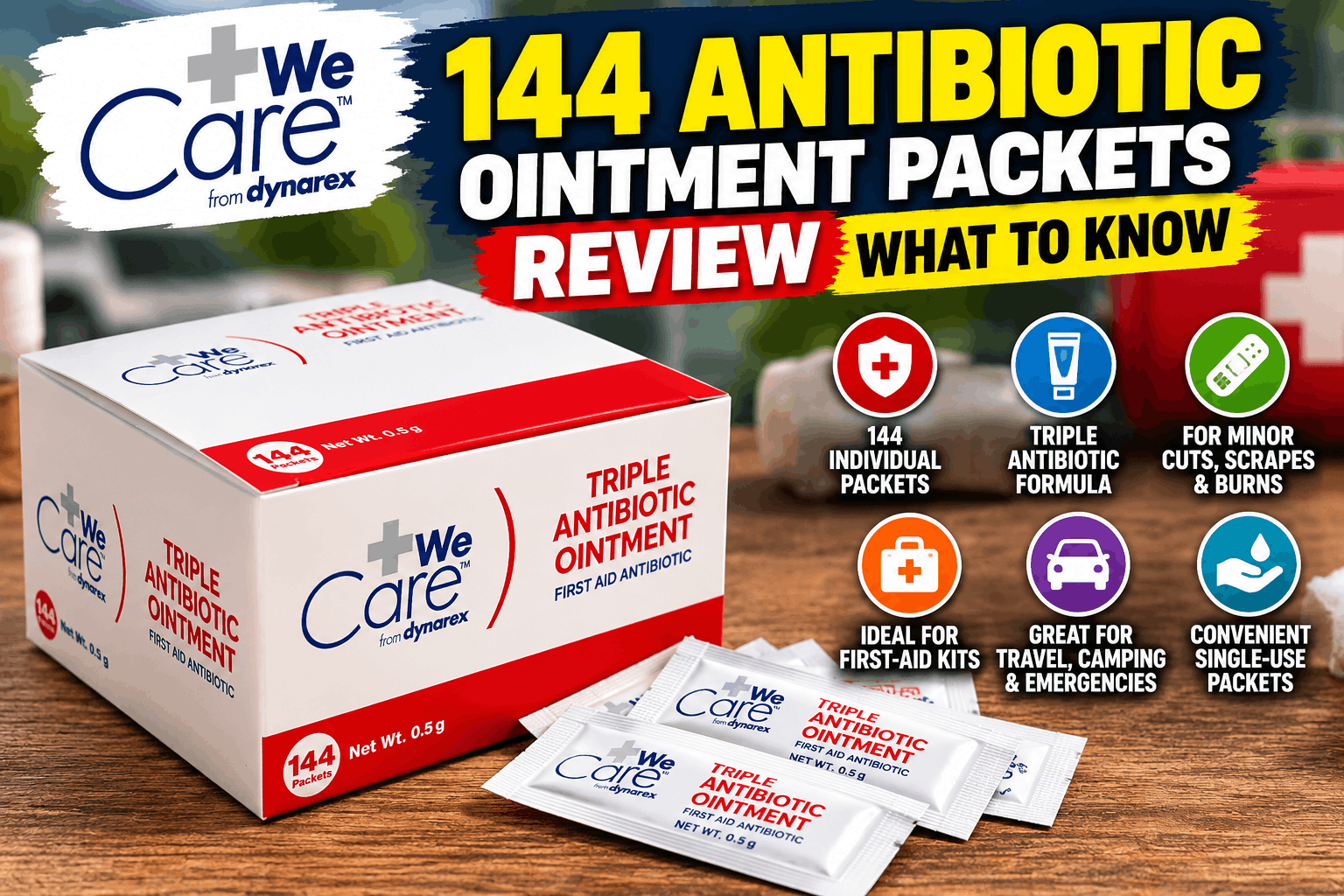
144 individual antibiotic ointment packets for minor cuts, scrapes, burns and first-aid preparedness.
144 Antibiotic Ointment Packets are designed to provide a convenient way to keep topical first-aid antibiotic treatment available for minor cuts, scrapes, and burns. The M462-144 format contains 144 individually packaged 0.5-gram packets, making it easier to distribute small amounts throughout home first-aid kits, vehicle kits, camping gear, workplace supplies, or emergency preparedness storage. The triple-antibiotic formula contains bacitracin zinc, neomycin sulfate, and polymyxin B sulfate. In this research-based review, we look at what comes in the box, the active ingredients, how the single-use packaging can help with organization and hygiene, appropriate uses, important warnings, storage considerations, and whether buying a large 144-packet supply makes sense for a preparedness-focused first-aid kit.
Research-Based Review: Based on published product information and medical labeling, we have not independently tested this product.
Quick Review
| Product | 144 Antibiotic Ointment Packets |
| Product Reference | M462-144 |
| Listed Price | $21.99 |
| Quantity | 144 individual packets |
| Packet Size | 0.5 gram per packet |
| Active Ingredients | Bacitracin Zinc, Neomycin Sulfate, Polymyxin B Sulfate |
| Intended Use | First aid to help prevent infection in minor cuts, scrapes, and burns |
| Form | Individual single-use topical packets |
What Are These 144 Antibiotic Ointment Packets?
The 144 Antibiotic Ointment Packets are a bulk first-aid supply intended for topical use on minor injuries. Rather than storing antibiotic ointment in one larger tube, the product is divided into individually packaged doses.
That format is particularly relevant for emergency preparedness because a single packet can be placed into a small first-aid pouch, vehicle kit, hiking pack, workplace cabinet, or travel bag without having to carry an entire tube.
The product reference M462-144 is associated with a triple-antibiotic ointment format containing bacitracin zinc, neomycin sulfate, and polymyxin B sulfate. Published product specifications identify 144 packets per box with 0.5 gram of ointment per packet.
Active Ingredients and What They Are For
The triple-antibiotic formulation combines three topical antibiotics. The published drug labeling identifies the following active ingredients per gram:
| Active Ingredient | Amount Per Gram | Purpose |
|---|---|---|
| Bacitracin Zinc | 400 units | First-aid antibiotic |
| Neomycin Sulfate | 5 mg | First-aid antibiotic |
| Polymyxin B Sulfate | 5,000 units | First-aid antibiotic |
The intended role is first aid to help prevent infection in minor cuts, scrapes, and burns. This should not be confused with treatment for serious wounds or significant infections.
Why Individual Packets Can Be Useful
The biggest practical advantage of the 144 Antibiotic Ointment Packets is the individual packaging. Instead of carrying a larger tube between different locations, you can distribute individual packets throughout multiple first-aid kits.
- Easy to place in compact first-aid kits
- Useful for vehicle emergency kits
- Convenient for camping and hiking supplies
- Practical for workplace or household first-aid storage
- Individual packaging reduces the need to repeatedly open a shared tube
- Allows multiple people or kits to have their own supply
For preparedness users, this distribution advantage can be more important than simply having a large tube of ointment sitting in one location.
Where These Packets Make the Most Sense
Home First-Aid Kits
Keeping several individual packets in a household first-aid kit can provide a compact topical antibiotic option for appropriate minor injuries.
Vehicle Emergency Kits
Individual packets take relatively little space and can be distributed between glove-box kits, roadside emergency bags, or larger vehicle medical supplies.
Camping and Outdoor Preparedness
For camping, hiking, hunting, or other outdoor activities, individual packets can be easier to pack than a larger tube. They can be stored alongside bandages, gauze, antiseptic supplies, and other first-aid essentials.
Long-Term First-Aid Storage
A 144-count box can also make sense for households, organizations, or preparedness groups that want to distribute supplies among several first-aid kits rather than maintaining one centralized tube.
How Is the Ointment Used?
According to the drug labeling for this triple-antibiotic formulation, the affected area should first be cleaned. A small amount of ointment can then be applied to the area one to three times daily, and the area may be covered with a sterile bandage.
The product should be used according to the directions and warnings on the specific package you receive. Do not assume that using more ointment or applying it more frequently will provide better protection.
Important Medical Safety Information
This is a topical antibiotic product for appropriate minor first-aid situations. It is not a substitute for professional medical care when a wound is serious or complications develop.
- For external use only.
- Do not use in the eyes.
- Do not apply over large areas of the body.
- Do not use if you are allergic to any of the ingredients.
- Do not use for longer than one week unless directed by a doctor.
- Ask a doctor before use for deep or puncture wounds, animal bites, or serious burns.
- Stop use and ask a doctor if the condition persists or gets worse.
- Stop use and seek medical advice if a rash or allergic reaction develops.
What These Packets Cannot Replace
Antibiotic ointment is only one small part of a properly stocked first-aid kit. The packets do not replace wound-cleaning supplies, sterile dressings, gauze, adhesive bandages, medical tape, gloves, or other appropriate first-aid equipment.
They also should not be treated as a general-purpose solution for every wound. Serious burns, deep wounds, puncture injuries, animal bites, spreading redness, worsening pain, persistent symptoms, or other concerning conditions may require professional medical evaluation.
Storage and Packet Condition
Published labeling for this formulation recommends storage at controlled room temperature, approximately 15–30°C (59–86°F), while avoiding excessive heat and humidity.
The packets are tamper-evident. Do not use an individual packet if it is torn, cut, opened, or otherwise compromised.
For emergency preparedness, it is also sensible to periodically inspect stored medical supplies for expiration dates, damaged packaging, or storage conditions that may have exposed the products to excessive heat or moisture.
What We Like
- 144 individual packets provide a substantial first-aid supply
- Compact 0.5-gram packet format is easy to distribute among multiple kits
- Triple-antibiotic formulation contains bacitracin, neomycin, and polymyxin B
- Useful for appropriate minor cuts, scrapes, and burns
- Convenient for home, vehicle, workplace, camping, and preparedness kits
- Individual packaging helps avoid repeatedly opening one shared tube
- Easy to organize alongside bandages and other wound-care supplies
What to Keep in Mind
- Not intended for serious or complicated wounds
- Must not be used in the eyes or over large areas
- People allergic to the ingredients should not use it
- Longer use requires medical direction
- Individual packets create more packaging waste than one reusable tube
- A 144-count supply may be more than a small household needs immediately
- We have not independently tested the product or its clinical performance
Is a 144-Packet Box Practical for Emergency Preparedness?
For someone building multiple first-aid kits, the larger quantity can be practical. Instead of purchasing one tube for every location, individual packets can be distributed among a home kit, vehicle kit, camping bag, workplace kit, and emergency storage.
At the listed price of $21.99, the cost works out to roughly 15 cents per packet. Whether that represents good value depends on how many first-aid kits you maintain and whether you will actually use or distribute the supply before expiration.
For a single person with one small household first-aid kit, 144 packets may be more inventory than necessary. For a preparedness-minded household with several kits or a larger emergency supply, the bulk format is easier to justify.
What to Check Before Buying
- Confirm the active ingredients and packet size on the package you receive.
- Check the expiration date before placing the product into long-term storage.
- Make sure the packet count fits the number of first-aid kits you maintain.
- Store the packets within the manufacturer’s recommended temperature range.
- Keep other wound-care supplies available rather than relying on ointment alone.
- Review the warnings if anyone who may use the product has known medication allergies.
- Replace damaged, opened, or compromised packets.
Preparedness Tip
Instead of keeping all 144 packets in one place, consider dividing appropriate quantities among your different first-aid kits. This can make the supply more useful during emergencies because the ointment is available where the rest of your wound-care supplies are stored.
Check the Current Price & Availability
The listed price for this product is $21.99. Pricing and availability can change.
Final Verdict: A Practical Bulk First-Aid Supply
The 144 Antibiotic Ointment Packets are best viewed as a convenient bulk addition to a well-rounded first-aid system rather than a standalone medical solution. The individual 0.5-gram packets make distribution easy, while the triple-antibiotic formulation provides a topical first-aid option for appropriate minor cuts, scrapes, and burns.
The main advantage is convenience. A box of 144 packets can be divided among several first-aid locations, reducing the need to move a single tube between home, vehicle, camping, workplace, and emergency kits.
The main limitation is also straightforward: antibiotic ointment has a specific role and should not be used as a substitute for professional care or a complete wound-care setup. The label’s restrictions regarding eyes, large areas, allergies, serious wounds, animal bites, serious burns, and prolonged use are important to follow.
Overall, this product makes the most sense for preparedness-minded buyers who maintain multiple first-aid kits or want a larger supply of individually packaged topical antibiotic ointment. For someone with only one small household kit, a 144-count box may be more than necessary.
Frequently Asked Questions
How many packets come in the box?
The product contains 144 individual antibiotic ointment packets.
How much ointment is in each packet?
The M462-144 format is listed as 0.5 gram per individual packet.
What are the active ingredients?
The triple-antibiotic formulation contains bacitracin zinc, neomycin sulfate, and polymyxin B sulfate.
What are these antibiotic ointment packets used for?
The labeled first-aid use is to help prevent infection in minor cuts, scrapes, and burns.
Can these packets be used on serious wounds?
No. The labeling advises asking a doctor before use on deep or puncture wounds, animal bites, or serious burns. More serious injuries may require professional medical evaluation and treatment.
How should the packets be stored?
Published labeling recommends controlled room-temperature storage between approximately 15°C and 30°C (59°F and 86°F), while avoiding excessive heat and humidity. Individual packets should also remain sealed and intact until use.
About the Author