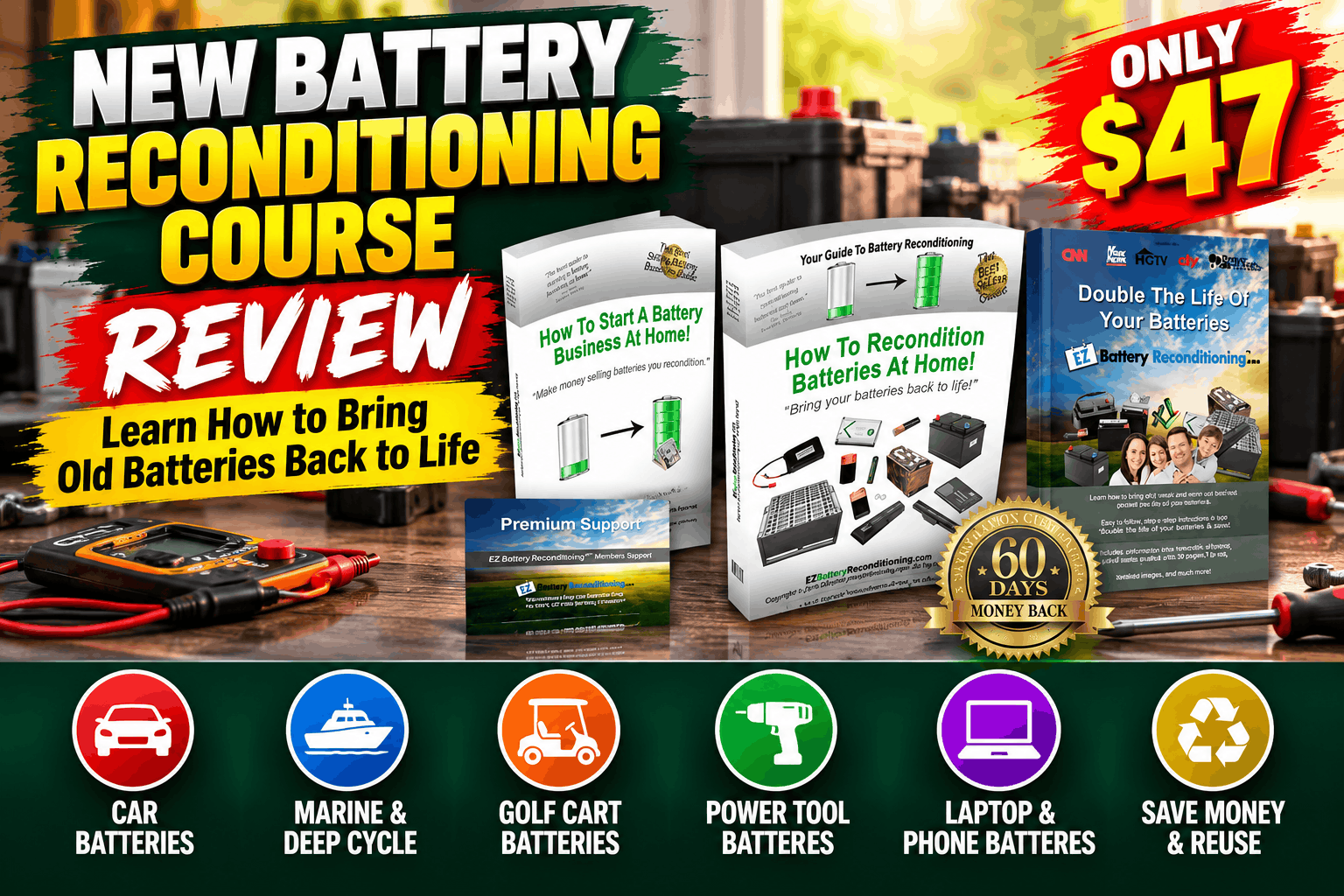
A preview of the digital battery-reconditioning guides and additional learning materials advertised with the course.
New Battery Reconditioning Course is a digital training program designed for people who want to learn about restoring and maintaining certain aging batteries instead of automatically replacing them. The program, marketed as EZ Battery Reconditioning, advertises illustrated step-by-step guides, a battery-business bonus, battery-life maintenance lessons, and ongoing support. The listed offer is $47 as a one-time payment, with a 60-day money-back guarantee advertised by the seller. But battery restoration is not a universal fix: results depend on battery chemistry, condition, and the reason its performance has declined. In this New Battery Reconditioning Course review, we’ll look at the materials, intended audience, practical limitations, safety considerations, and what buyers should verify before ordering.
Research-Based Review:, Based on published product information and research, we have not independently tested this product.
Quick Review: New Battery Reconditioning Course
| Product type | Digital battery-reconditioning training program |
| Brand/program name | EZ Battery Reconditioning |
| Listed price | $47 one-time payment; verify the checkout price |
| Delivery | Digital guides and downloadable materials |
| Advertised inclusions | Step-by-step guides, bonus resources, lifetime updates and support |
| Refund policy | 60-day money-back guarantee, according to the seller |
| Hands-on testing | Not performed for this review |
Details reflect the supplied product information and advertised offer; confirm current terms before purchasing.
What Is the New Battery Reconditioning Course?
The New Battery Reconditioning Course is marketed as a practical learning resource for people interested in battery care, testing, maintenance, and attempting to restore the performance of suitable batteries. The program’s promotional materials describe instructions with pictures and diagrams so users can follow the procedures rather than rely entirely on text.
The seller says the course covers several battery categories, including lead-acid batteries used in cars, marine applications, golf carts, and other equipment, along with certain rechargeable batteries used in tools and electronics. However, different battery chemistries require different procedures, and a method intended for one type must not automatically be applied to another.
It is important to understand what you are buying. New Battery Reconditioning Course is a digital information product, not a battery-repair machine, a box of replacement parts, or a new battery. You receive instructional materials; any tools, chargers, testing equipment, protective equipment, or replacement components needed for a particular job are separate considerations.
What Is Included in the Course?
According to the supplied sales copy, the package contains the following educational resources. Exact access details and the current bonus bundle should be confirmed on the seller’s checkout page.
Illustrated Battery-Reconditioning Guides
The core materials are described as step-by-step guides with images and diagrams. The goal is to help users understand the process and identify the relevant steps for different battery types. We have not independently inspected every guide or verified every procedure it contains.
Frank’s Battery Business Guide
The offer advertises an additional guide about sourcing used batteries, reconditioning suitable units, and reselling them. This may interest readers exploring a battery-related side business, but the bonus does not establish that a business will be profitable. Local regulations, safe handling, sourcing, demand, and resale costs all matter.
Double the Life of Your Batteries Mini-Course
The seller also promotes a mini-course focused on battery maintenance and habits intended to help extend battery life. The phrase “double the life” is a promotional claim, not a guaranteed outcome for every battery.
Lifetime Updates and Support
The supplied offer describes ongoing updates and customer support as part of the purchase. Check the current terms to understand how support is accessed, what it covers, and whether the advertised lifetime access applies to all materials.
Which Batteries Does It Cover?
The sales material names a broad range of battery categories, but coverage should not be confused with a guarantee that every battery can be restored. The listed examples include:
- Car and other lead-acid batteries.
- Deep-cycle, marine, golf-cart, and wheelchair batteries.
- Scooter and forklift batteries.
- Certain rechargeable power-tool batteries.
- Laptop and mobile-device batteries.
- Rechargeable AA, AAA, C, and D cells.
These battery types can have substantially different designs and safety requirements. Some sealed battery packs are not intended to be opened or serviced by consumers. Before following any procedure, confirm that it is specifically appropriate for the exact chemistry and model involved.
What Makes the Course Appealing?
Potential Advantages
- Visual instruction: The seller describes guides with pictures and diagrams.
- Multiple battery categories: The advertised materials discuss several types of batteries rather than only one category.
- Reusable knowledge: Battery testing and maintenance knowledge may be useful across future projects.
- Digital delivery: The guides are advertised for access on computers, tablets, and smartphones.
- Additional learning resources: The offer includes advertised bonus materials about battery-related business and maintenance.
- Ongoing support and updates: These are listed as included benefits, subject to the current offer’s terms.
These are advantages of the advertised learning format, not proof of restoration success. The usefulness of the New Battery Reconditioning Course depends on the quality of its instructions and whether the procedures are suitable for the batteries a buyer actually owns.
Limitations to Consider Before Buying
Important Limitations
- No physical equipment: The purchase is for digital educational content.
- Results vary: Not every old, weak, or non-functioning battery can be restored.
- Extra tools may be required: Testing equipment, chargers, and protective gear may add to the overall cost.
- Different chemistries need different methods: A procedure suitable for one battery may be unsafe or ineffective for another.
- Seller claims are not independent test results: The advertised savings and testimonials have not been verified for this review.
- Business income is not guaranteed: A bonus guide cannot ensure profitable sourcing or resale.
Can Battery Reconditioning Actually Work?
Battery reconditioning is not a single process that works on every battery. In some circumstances, a battery may regain some useful capacity or remain serviceable longer after an appropriate maintenance or recovery procedure. The result depends on the battery’s chemistry, age, condition, and the mechanism responsible for its decline.
For example, certain lead-acid batteries can lose performance because of sulfation, and some forms of degradation may be partially reversible. But physical damage, severe wear, internal faults, or other failure mechanisms may make recovery impractical or impossible. A battery that appears to accept a charge may still have poor capacity or be unreliable under load.
The seller’s broad claims about restoring batteries should therefore be treated cautiously. We have not independently tested the New Battery Reconditioning Course, measured restored capacity, or confirmed its advertised customer savings. A useful evaluation would compare a battery’s condition before and after a suitable procedure using appropriate testing equipment and safe, repeatable methods.
Safety: When Not to Attempt Reconditioning
Read Before Working on Batteries
Battery work can involve corrosive electrolytes, hazardous gases, high currents, electrical shock, short circuits, and fire. Use the manufacturer’s guidance for the specific battery, appropriate protective equipment, ventilation, and suitable tools.
- Do not attempt to recondition batteries that are swollen, leaking, cracked, overheated, or physically damaged.
- Do not open sealed or lithium-ion battery packs unless the manufacturer explicitly provides a suitable service procedure for qualified personnel.
- Never short battery terminals or use an improvised charging method.
- Keep sparks and flames away from batteries that may release flammable gas.
- Use a qualified technician when the procedure or battery type is outside your knowledge.
If a battery is unsafe or beyond repair, stop using it and follow local guidance for proper recycling or disposal.
Price and Refund Policy
The supplied product information lists the New Battery Reconditioning Course at $47 as a one-time payment. The seller also advertises a 60-day money-back guarantee, digital access, lifetime updates, and lifetime support. Because promotions and terms can change, confirm the final price and all inclusions on the checkout page before placing an order.
The advertised price is for the training materials, not for the equipment needed to work on batteries. If you are budgeting for a project, include any suitable charger, multimeter, protective gear, replacement parts, or professional service that may be necessary.
The guarantee gives eligible buyers a stated period to evaluate the purchase, but it is not a guarantee that a battery can be repaired or that the course will generate savings. Review the refund instructions and save your order confirmation.
Who May Find This Course Useful?
The New Battery Reconditioning Course may interest DIY learners who regularly work with suitable batteries, want to understand battery maintenance, and are prepared to learn the safety requirements for each battery type. It may also appeal to people who prefer illustrated digital instructions over searching for disconnected information online.
It is less suitable for someone expecting a machine or physical kit, a guaranteed way to revive every dead battery, or a reliable income stream from reselling restored batteries. Readers who need a battery for a critical application should prioritize a correctly rated, dependable replacement over an unverified restoration attempt.
Check the Current Course Offer
Explore the Course Materials
Review the current package, included guides, support details, and refund terms before deciding.
Final Verdict
The New Battery Reconditioning Course is an advertised digital training package for people who want to learn about battery restoration, maintenance, and related DIY projects. The seller lists illustrated guides, additional bonus resources, lifetime updates and support, and a $47 one-time offer with a 60-day money-back guarantee.
Its strongest potential appeal is the chance to build reusable knowledge about battery care and learn how to assess certain aging batteries before deciding whether replacement is necessary. However, the course’s promotional claims about savings and restoration results are not independently verified in this review, and no method can restore every battery.
Our recommendation is to consider the course as educational material, not as a guaranteed repair solution or business opportunity. Verify the package contents, check the refund terms, and follow battery-specific safety guidance. If you need dependable performance for a vehicle, medical device, emergency system, or other critical application, use an appropriate tested battery or consult a qualified technician.
Frequently Asked Questions
What should I check before deciding whether a battery is suitable for reconditioning?
Identify the battery chemistry and model, inspect it for visible damage, and consult the manufacturer’s guidance. A suitable testing procedure can help establish its condition, but visual inspection alone cannot confirm remaining capacity or safety.
Can knowledge from the course be used for a battery-related business?
The seller advertises a bonus about sourcing and reselling used batteries. Turning that information into a business would also require safe handling practices, local regulatory compliance, reliable sourcing, demand research, and realistic cost calculations; profits are not guaranteed.
What if a battery appears to work after a restoration attempt but fails under load?
A battery may show voltage or accept a charge without delivering dependable usable capacity. It should be evaluated with appropriate testing for its intended application, and it should not be relied on for critical use unless it meets the required performance specifications.
How should batteries that cannot be restored be handled?
Stop using batteries that are damaged or unsafe, and do not put them in ordinary household waste where local rules prohibit it. Follow local battery-recycling guidance or contact an appropriate recycling facility for instructions specific to the battery type.
About the Author